Ultimate Guide to Industrial Leases in Oklahoma
Leasing industrial property in Oklahoma involves understanding cost structures, lease types, zoning laws, and market trends. Here's what you need to know:
- Triple Net (NNN) Leases Dominate: Tenants pay a base rent plus property taxes, insurance, and maintenance fees (typically $2.00–$4.00 per square foot annually). Always calculate the total cost upfront.
- Lease Types: Modified Gross and Full-Service leases offer alternative cost-sharing structures but are less common in industrial real estate.
- Key Costs: Base rent in Oklahoma City ranges from $12–$14 per square foot (NNN), with tenant improvement costs between $10–$20 per square foot.
- Zoning Compliance: Verify zoning categories (e.g., I-1 for light industrial or I-3 for heavy industrial) to ensure the property suits your business.
- Growing Industrial Hubs: Oklahoma City, Pryor (MidAmerica Industrial Park), Inola, and Owasso are key areas for industrial growth, each offering distinct advantages for different industries.
- Negotiation Tips: Request CAM caps (around 5%), clarify maintenance responsibilities, and secure audit rights to avoid unexpected costs.
For businesses in warehousing, manufacturing, or distribution, understanding these factors is essential for securing a lease that aligns with your needs and budget.
Industrial Property Lease Structures Explained
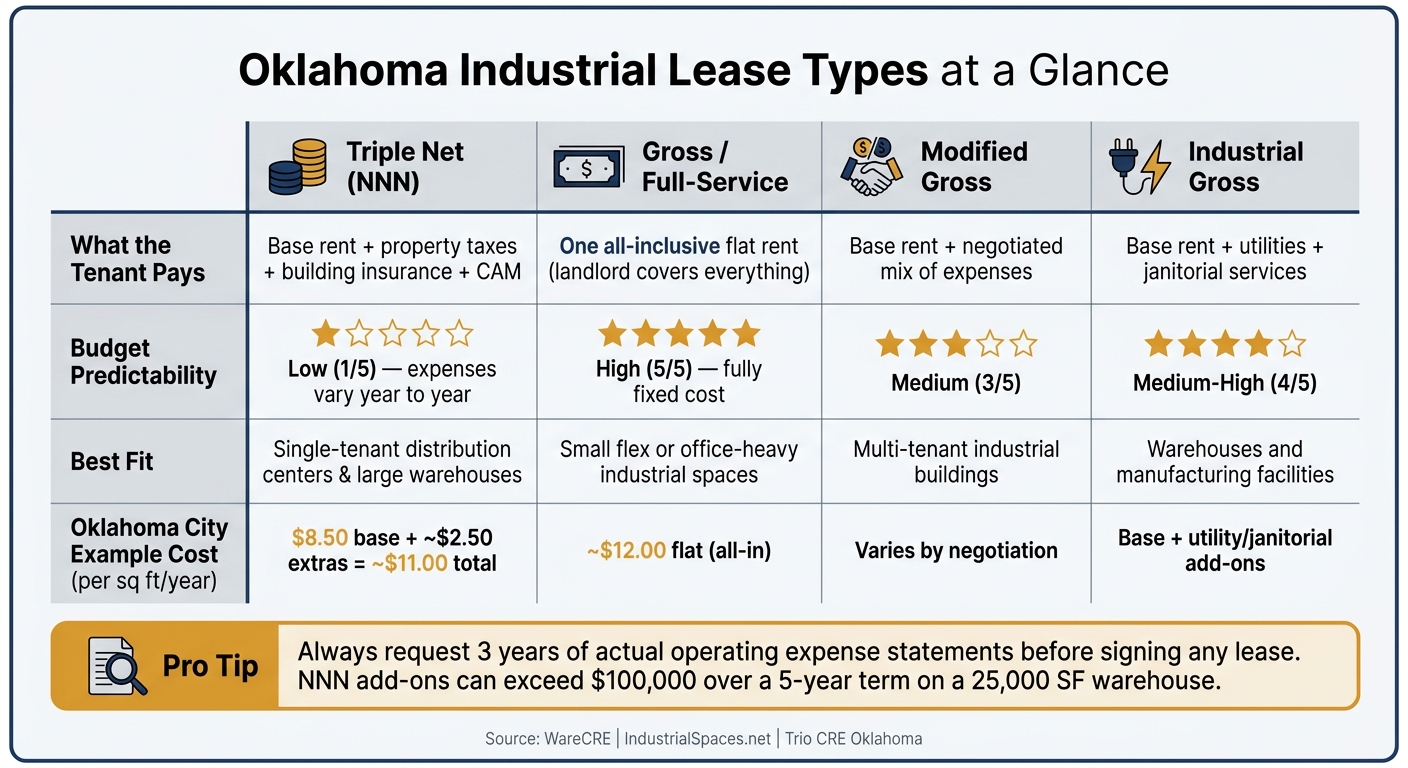
Oklahoma Industrial Lease Types Compared: NNN vs. Gross vs. Modified Gross
Understanding industrial lease structures is crucial because they define who pays for what, significantly influencing long-term costs.
Triple Net (NNN) Leases
The Triple Net (NNN) lease is the go-to structure in industrial real estate. Under this arrangement, tenants pay a base rent plus three additional expense categories: property taxes, building insurance, and Common Area Maintenance (CAM). CAM typically includes costs for things like parking lot upkeep, landscaping, exterior lighting, and property management fees.
"The triple net lease - commonly written as 'NNN' - is the dominant lease structure in industrial real estate." - WareCRE
For example, an advertised rate of $8.50/SF NNN might actually total around $11.00/SF once you factor in taxes (~$1.25/SF), insurance (~$0.40/SF), and CAM (~$0.85/SF). Over a five-year period, a 25,000 SF warehouse could see additional costs exceeding $100,000.
When negotiating an NNN lease, there are a few ways to protect yourself from unexpected expenses:
- Request a CAM cap: Negotiate a limit on annual CAM increases, ideally around 5%.
- Ask for audit rights: Ensure you can verify the landlord's expense calculations.
- Clarify repair responsibilities: Confirm who is liable for major repairs like HVAC replacements or roof maintenance, as these details may not be obvious from the lease terms.
"Triple net leases aren't just a financial tool - they're a mindset. For landlords, it's about passive income and risk mitigation. For tenants, it's about operational control and transparency." - IndustrialSpaces.net
Now, let's look at alternative lease structures that offer different ways to share costs and provide varying levels of predictability - an essential consideration in markets like Oklahoma, where precise cost planning can make or break a deal.
Modified Gross and Full-Service Leases
While NNN leases dominate the industrial sector, alternative lease structures can sometimes be a better fit, depending on your operational needs.
With a Modified Gross lease, expenses are divided between the landlord and tenant through negotiation. A common variant in industrial real estate is the Industrial Gross lease, where tenants pay base rent plus specific costs - such as utilities and janitorial services - while the landlord handles property taxes, insurance, and structural maintenance. This setup offers a more predictable monthly budget, although tenants still cover their operational costs like electricity.
On the other hand, a Full-Service (Gross) lease bundles all costs into a single flat rent. The landlord takes care of all operating expenses. While these leases are rare in industrial spaces, they do pop up occasionally in smaller flex spaces. For example, a property listed at $12.00/SF Gross might be more affordable than an $8.50/SF NNN lease after factoring in additional charges.
| Lease Type | Tenant Pays | Budget Predictability | Best Fit |
|---|---|---|---|
| Triple Net (NNN) | Base rent + taxes + insurance + CAM | Low – expenses can vary | Single-tenant distribution centers |
| Gross / Full-Service | One all-inclusive rent | High – fixed cost | Small flex or office-heavy spaces |
| Modified Gross | Base rent + negotiated expenses | Medium | Multi-tenant industrial buildings |
| Industrial Gross | Base rent + utilities + janitorial | Medium-High | Warehouses, manufacturing |
Before committing to any lease, always request at least three years of actual operating expense statements from the landlord. Relying solely on estimates could leave you with unexpected surprises down the line.
Key Industrial Locations in Oklahoma
Oklahoma's central position along major interstates and rail lines offers a clear logistical edge by reducing transportation costs and speeding up supply chains.
"Oklahoma is the center of the country, and that is a huge advantage from a distribution standpoint. We offer a skilled workforce, robust energy availability, strong economics, and superior logistics." - John Budd, CEO, Oklahoma Department of Commerce
With a corporate income tax rate of just 4% - one of the lowest in the nation - and 42% of its electricity coming from renewable energy sources (placing it fourth nationwide), Oklahoma has become a magnet for industrial tenants.
Oklahoma City Industrial Parks
As Oklahoma's largest industrial market, Oklahoma City has seen a surge in speculative developments and tenant relocations, which led to record-high vacancy rates in early 2024.
"The delivery of large projects and several significant move-outs have driven vacancy rates to decade-high levels at the beginning of the year." - Price Edwards and Company
For businesses, these high vacancy rates mean better opportunities to negotiate on rent, tenant improvement packages, and lease terms. Additionally, rent growth in the area has plateaued over the past year.
While Oklahoma City remains a key player, other regions in the state are carving out their own niches in the industrial sector.
Growing Industrial Areas Outside Oklahoma City
Beyond Oklahoma City, areas like Pryor, Inola, and Owasso are stepping into the spotlight, each offering specialized advantages for different industries.
Pryor (MidAmerica Industrial Park)
Home to the massive MidAmerica Industrial Park, Pryor boasts 9,000 acres of industrial space, making it the largest in Oklahoma and the fifth largest in the U.S. Major companies like Google, Chevron Phillips, and Siemens Energy have set up shop here, drawn by features like onsite rail, airfield access, and expedited permitting processes. The park also benefits from a labor pool of 214,000 workers within a 40-minute commute.
Inola
Inola is positioning itself as a hub for heavy industry, thanks in part to its port access and facilities tailored to energy-intensive operations. A notable development here is the primary aluminum production plant announced by Emirates Global Aluminum and Century Aluminum Company in January 2026. This 437.5-acre facility - the first of its kind in the U.S. since 1980 - will produce 750,000 tons of aluminum annually, create 1,000 permanent jobs, and require 1.2 gigawatts of continuous power.
Owasso
Located in the Tulsa metro area, Owasso is geared toward small and mid-sized manufacturers. The recently launched Robinson Industrial Park offers units ranging from 3,500 to 12,000 square feet, complete with drive-through overhead doors and professional loading docks. Its location near Highways 75 and 169 provides businesses with excellent connectivity and practical infrastructure.
| Industrial Hub | Best For | Key Infrastructure | Notable Tenants/Projects |
|---|---|---|---|
| Pryor (MidAmerica) | Large-scale manufacturing & data centers | Onsite rail, airfield access, fast-track permitting | Google, Chevron Phillips, Siemens Energy |
| Inola | Heavy industry, energy-intensive operations | Port access, 437.5-acre sites | Emirates Global Aluminum, Century Aluminum |
| Owasso | Small-to-mid-sized manufacturers | Highway 75/169 access, flexible unit sizes | Robinson Industrial Park tenants |
How to Calculate Costs and Space Requirements
Start by pinpointing a location and ensuring that the total costs fit within your budget.
Breaking Down Total Leasing Costs
Base rent is just the starting point. For example, in Oklahoma City, base rent usually falls between $12–$14 per square foot (NNN) annually. In Tulsa, industrial spaces can sometimes be found for less than $6 per square foot per year. On top of that, NNN expenses - which cover property taxes, insurance, and maintenance - typically add $2.00–$4.00 per square foot. Additionally, CAM charges (common area maintenance) range from $0.50 to $1.50 per square foot annually to cover shared services like parking, lighting, landscaping, and management.
To figure out your total leasing cost, use this formula:
Total Annual Cost = (Base Rent + NNN Expenses) × Total Square Footage
Divide the result by 12 to calculate your monthly cost. Always ask for the last three years of operating expense statements to avoid relying solely on estimates.
If tenant improvements are necessary - such as adding a roll-up door or upgrading electrical systems to handle heavy equipment - don't forget to include these in your budget. Tenant improvement allowances in Oklahoma City generally range between $10 and $20 per square foot. Specialized electrical upgrades, however, can cost anywhere from $20,000 to over $100,000, depending on your equipment needs.
Once you have a clear understanding of costs, align them with your space requirements.
Estimating Space Based on Business Use
After confirming your leasing expenses, evaluate whether the space meets your operational needs.
Balancing costs with efficient use of space is key to long-term success. While square footage is important, the volume of the space can make a big difference. For instance, a warehouse with a 28-foot clear height provides much more usable storage volume than one with a 14-foot ceiling, allowing for taller pallet stacking. Before committing to a space, plan for pallet layouts, stacking heights, and aisle widths to ensure safe forklift operations.
It’s also important to know whether you're paying for Usable Square Footage (USF) - the actual area you occupy - or Rentable Square Footage (RSF), which includes shared common areas. For instance, in a multi-tenant building with a common area factor of about 16.7%, a 3,000 USF space could translate to roughly 3,501 RSF, increasing your rent.
In Oklahoma City, industrial spaces typically range from 5,000 to over 100,000 square feet. If your business is growing, consider spaces with room for expansion or renewal rights in your lease. By carefully analyzing your costs and space needs, you’ll be better prepared to negotiate terms with experts like Trio CRE.
Zoning Laws and Legal Requirements for Industrial Leases
Once you've settled on costs and space, the next step is ensuring the property is legally approved for your operations. Legal compliance is just as important as budgeting and space planning because overlooking it can lead to fines, forced relocations, or expensive delays. In Oklahoma, zoning laws dictate what activities are allowed in a building, making it essential to verify this upfront.
Zoning and Land Use Regulations
Oklahoma cities typically organize industrial land into four zoning categories, each with its own set of rules for permitted activities and management:
| Zoning Category | Primary Use | Key Rules |
|---|---|---|
| I-P (Industrial Park) | Research, administrative tasks, specialized manufacturing | Must avoid environmental nuisances and align visually with surroundings |
| I-1 (Light Industrial) | Warehousing, light assembly, light manufacturing | Noise, odor, and dust must be contained within enclosed buildings |
| I-2 (General Industrial) | Trucking terminals, machine shops, fabrication | Allows low-level noise and odor; outdoor storage permitted with proper screening |
| I-3 (Heavy Industrial) | Refineries, meatpacking, bulk chemical storage | High-impact emissions allowed; security fencing required |
Additional restrictions often apply. For example, many cities in Oklahoma cap building heights at 45 feet, limit lot coverage (including parking) to 80%, and mandate that I-3 storage tanks or loose material piles be set back at least 100 feet from property lines.
Your business type also affects zoning requirements. For instance, medical marijuana growing and processing is typically confined to I-1 zones and must be fully enclosed. Similarly, businesses relying on heavy rail or air freight are better suited for I-2 or I-3 zones, as I-1 areas are generally geared toward smaller freight operations.
"If the zoning doesn't match your business model, none of that matters." - IndustrialSpaces.net
Always verify the zoning designation through official channels, and be aware of overlay districts (like environmental or historical overlays) that may impose additional restrictions beyond the base zoning rules.
Once zoning is confirmed, the next step is inspecting the property to ensure it aligns with lease requirements and operational needs.
Property Inspections and Lease Compliance
After zoning is verified, conducting thorough property inspections is critical. Start with a Phase I Environmental Site Assessment (ESA) to check for prior contamination, underground storage tanks, or any history of hazardous materials on the property. If Phase I raises concerns, follow up with a Phase II ESA, which includes soil and groundwater testing. Early detection is key, as remediation costs can range from $10,000 for minor issues to over $1,000,000 for severe contamination.
Industrial leases often come with specific compliance requirements, such as stormwater management, hazardous materials handling (including SPCC plans), and air quality monitoring. These requirements directly impact lease terms and may influence negotiations. If the property has a non-conforming use status - meaning it’s grandfathered under older zoning laws - be cautious. Renovations or changes to the property could void this status, leading to compliance issues.
It’s also important to plan for potential delays. For example, obtaining a Conditional Use Permit (CUP) can take 2–4 months, while full rezoning may require 3–6 months or more. To protect yourself, include a zoning contingency clause in your lease agreement. This clause provides an exit option if necessary permits are denied or the property fails to meet regulatory requirements for your operations.
Negotiating Industrial Leases with Trio CRE

Once zoning is confirmed and property inspections are complete, the next critical step is negotiating a lease that aligns with your operational needs. This step is essential for finalizing your industrial leasing strategy, and Trio CRE brings expertise to the table to make this process seamless.
Tenant Representation Services
Trio CRE provides comprehensive tenant representation services at no cost to tenants (fees are covered by the landlord). Their support covers every stage of the leasing process, including:
- Conducting market surveys that include both public listings and off-market opportunities.
- Organizing property tours to evaluate potential spaces.
- Performing financial analyses to assess lease terms.
- Handling lease negotiations and coordinating the move.
For businesses with unique operational requirements - such as heavy power needs, ESFR sprinkler systems, or manufacturing-grade infrastructure - Trio CRE goes the extra mile by conducting technical evaluations. This ensures the facility meets your specific needs before you sign on the dotted line. They also assist in negotiating tenant improvement (TI) allowances, helping to minimize upfront costs for custom build-outs.
Market Data and Leasing Strategy
Trio CRE leverages local market data to strengthen your leasing position. For example, in Oklahoma City, industrial spaces typically rent for $12–$14 per square foot NNN, with lease terms generally ranging from 3 to 5 years. Their submarket analysis focuses on key industrial corridors, such as areas near Oklahoma City International Airport (OKCIA) and North Oklahoma City, which offer excellent access to transportation hubs.
Planning for future growth is another priority. Trio CRE evaluates whether a space can accommodate your expanding operations, helping avoid mid-lease relocations that can disrupt your business. To manage long-term costs, they recommend negotiating caps on common area maintenance (CAM) charges - typically around 5% annually - to keep operating expenses predictable.
With Trio CRE’s expertise, you’ll be equipped to secure a lease that not only meets your current requirements but also supports your long-term operational goals.
Key Takeaways for Leasing Industrial Properties in Oklahoma
In Oklahoma's industrial property market, Triple Net (NNN) leases are the standard. This means tenants pay a base rent plus an additional $2.00–$4.00 per square foot (SF) to cover taxes, insurance, and common area maintenance (CAM) fees. To make informed comparisons, calculate the total annual occupancy cost upfront.
When evaluating properties, physical specifications are just as critical as pricing. Features like clear height, loading dock setup, floor load capacity, and power availability can significantly influence operational efficiency. A warehouse that seems affordable might require costly upgrades if these specs fall short of your needs.
Zoning compliance is another key consideration. Double-check that the property aligns with your intended use. Additionally, clearly outline maintenance responsibilities in the lease. Negotiate for a CAM cap - around 5% - and secure audit rights to maintain control over long-term expenses.
To avoid unexpected relocations during the lease term, include flexibility clauses like expansion rights and renewal options. For example, over a five-year lease for a 25,000 SF warehouse, the structure of your lease could affect costs by more than $100,000. These details can make a significant difference, so work closely with industry professionals to ensure favorable terms.
FAQs
What should I ask for to confirm the “all-in” cost of an NNN lease?
When reviewing the "all-in" cost of an NNN lease, it's essential to ask for a detailed breakdown of every expense. This should cover rent, property taxes, insurance, maintenance, and utilities. Having all costs clearly itemized ensures there are no unexpected charges down the line.
Which building specs matter most for my warehouse or manufacturing use?
Key factors to consider when planning warehouses or manufacturing spaces include:
- Ceiling height: Crucial for accommodating storage racks or large equipment.
- Loading dock access: Essential for smooth and efficient logistics operations.
- Power capacity: Necessary to support heavy machinery and equipment.
Other important considerations include layout flexibility to adapt to changing needs, reliable HVAC systems for climate control, and effective fire suppression systems for safety. Additionally, the location of the facility plays a big role - being close to transportation hubs and a reliable labor pool can significantly enhance operational efficiency and reduce long-term costs.
What permits or environmental checks could delay my move-in?
Permits and environmental reviews can slow down move-in timelines, especially when issues like soil contamination, groundwater pollution, or hazardous materials are discovered. To tackle these concerns, environmental site assessments - commonly referred to as Phase I and sometimes Phase II assessments - might be necessary. These evaluations help identify and address potential risks.
On top of that, adhering to various regulations at the local, state, and federal levels adds another layer of complexity. This includes meeting zoning requirements and complying with pollution control laws. Securing the required permits or approvals can take a considerable amount of time, depending on the specifics of the property and the regulations in place.