
Study: Tenant Mix Effects on Property Value
Tenant mix matters. It directly impacts property value, rental income, and long-term financial performance. A diverse combination of tenants can stabilize cash flow, reduce risks, and attract investors, while poor tenant selection can lead to income loss and higher vacancy rates.
Key takeaways from the study:
- Tenant diversity boosts value: Properties with varied tenants often command higher rents and lower cap rates.
- Anchor tenants are critical: They drive foot traffic and support smaller tenants but can pose risks if over-relied upon.
- Market-specific strategies work: Tailoring tenant mix to local needs, like in Oklahoma City, improves property success.
- Balance is key: Combining long-term leases with flexible short-term ones ensures stability and adaptability.
In short, tenant mix isn't just about filling spaces - it's about creating synergy that enhances property performance and minimizes risks.
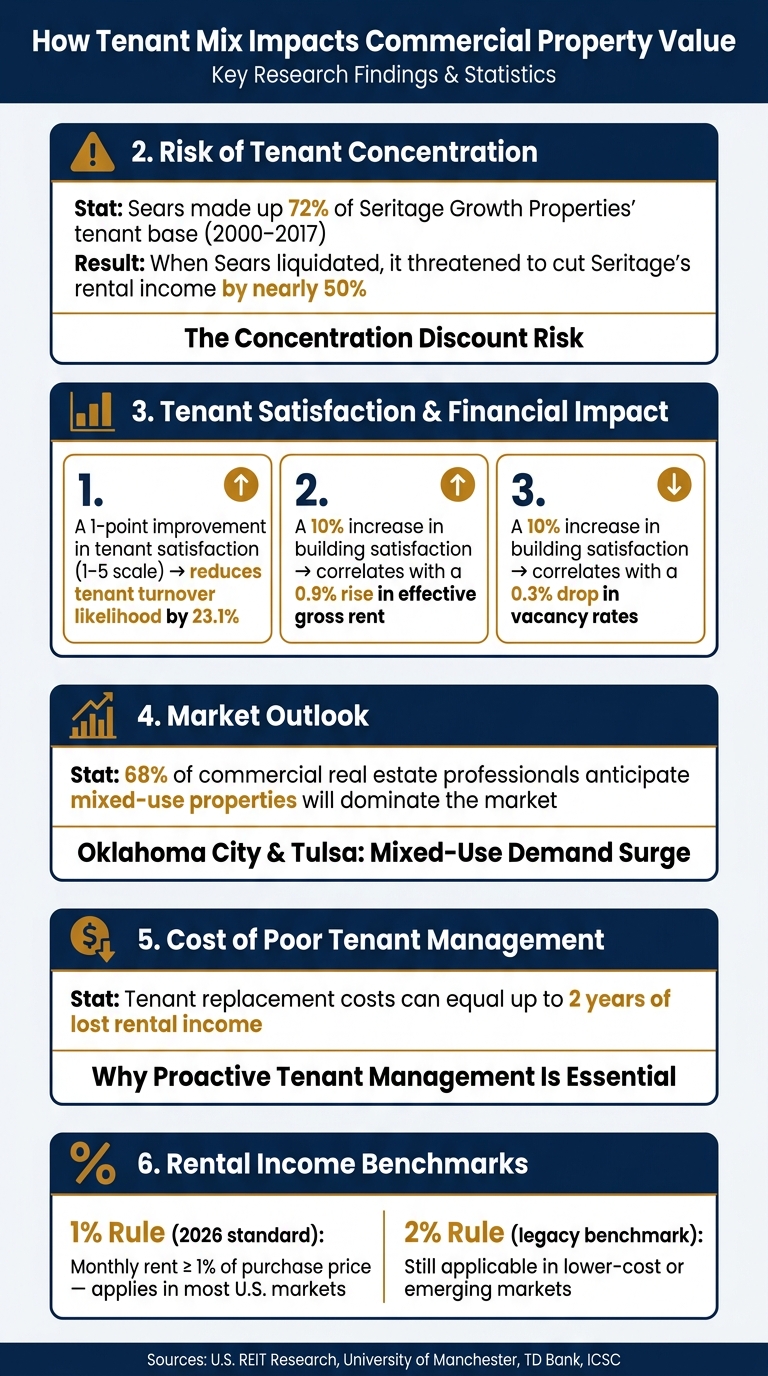
How Tenant Mix Impacts Commercial Property Value: Key Stats
How Tenant Mix Impacts Financing & Property Value
What Research Says About Tenant Mix and Property Value
Studies clearly show that the mix of tenants in a property directly affects rental income, property value, and long-term performance. Research conducted in the Netherlands and the UK highlights that properties with a diverse tenant mix - measured using tools like the reciprocal Herfindahl index - tend to command higher rents and are more appealing to potential tenants and investors alike. These findings, while international, also have relevance for markets in the U.S., including Oklahoma, as discussed in later sections. This diversity not only boosts rental income but also helps stabilize cash flows, which we’ll explore in the next part.
How Tenant Diversification Affects Cash Flow Stability
Tenant diversification acts as a financial safety net, offering benefits beyond simply filling vacant spaces. Research on U.S. REITs (Real Estate Investment Trusts) reveals that properties with a concentrated tenant base may experience higher short-term cash flows due to lower management costs. However, this approach often comes with increased liquidity risks and slower growth in dividends, a phenomenon often referred to as a "concentration discount".
Ryan G. Chacon from the University of Colorado adds that banks factor tenant concentration risks into their lending decisions. REITs with less diversified tenant portfolios often face higher borrowing costs as a result. A real-world example of this risk is Seritage Growth Properties. Between 2000 and 2017, Sears made up about 72% of Seritage's tenant base. When Sears liquidated, it threatened to cut Seritage's total rental income by nearly 50%.
In addition to minimizing income risks, a well-balanced tenant mix can build further financial resilience, particularly when the property includes anchor tenants.
The Role of Anchor Tenants in Property Value
Anchor tenants are a cornerstone of commercial real estate, playing a vital role in driving foot traffic and creating value for the entire property. These tenants attract customers from a wide area, generating what’s known as shopping externalities that benefit smaller businesses within the same property. This dynamic often leads to the inclusion of co-tenancy clauses in leases, allowing smaller tenants to renegotiate rent or terminate leases if a major anchor tenant leaves.
Here’s a quick overview of how anchor tenants influence property performance:
| Impact Area | Role of Anchor Tenants | Impact on Smaller Tenants |
|---|---|---|
| Foot Traffic | Draw customers from a broad geographic area | Smaller tenants benefit from increased spillover traffic |
| Financials | Provide stable, long-term leases with strong credit profiles | Co-tenancy clauses may lower rents if an anchor tenant vacates |
| Synergy | Enhance the property’s reputation as a destination | Encourage cross-shopping and shared customer bases |
| Risk | Reduce vacancy risk through long-term commitments | Smaller tenants may face challenges if the anchor loses its draw |
Anchor tenants not only stabilize a property's financial performance but also enhance its overall appeal, creating a ripple effect that benefits the entire tenant ecosystem. However, over-reliance on a single anchor can also introduce risks, underscoring the importance of a balanced approach.
Tenant Mix Effects in Oklahoma's Commercial Real Estate Market
Oklahoma's commercial real estate market offers a fascinating look at how tenant mix decisions can significantly influence property success. With an economy rooted in energy, agriculture, and technology - and urban areas experiencing rapid growth - what works for one property might not work for another. The key lies in tailoring tenant combinations to the specific location and property type.
Oklahoma Market Trends and Regulations Affecting Tenant Mix
Several trends are shaping how property owners in Oklahoma approach tenant selection. Urban expansion in Oklahoma City and Tulsa has driven demand for mixed-use developments that combine retail, dining, and residential spaces. According to an industry survey, 68% of commercial real estate professionals anticipate that mixed-use properties will dominate the market in the near future.
Simultaneously, the return to in-person work has shifted priorities for office landlords. Many are now rethinking their tenant strategies to make office spaces more appealing. As Hugh Allen, Head of U.S. Commercial Real Estate at TD Bank, explains:
"As employees return to in-person work, they crave unique, meaningful workplace experiences that make coming into the office a positive experience."
To stay competitive, office property owners in Oklahoma are pairing traditional tenants with amenities like fitness centers, cafeterias, and collaborative spaces.
In smaller districts, fragmented ownership presents a unique challenge. When multiple independent property owners make leasing decisions without coordination, it can lead to an oversupply of similar tenants. The International Council of Shopping Centers has emphasized that tenant selection is critical for driving customer traffic and ensuring the profitability of retail spaces. This principle applies not only to large malls but also to smaller neighborhood districts.
The following examples from Oklahoma City highlight how a well-planned tenant mix can directly improve property performance.
Oklahoma Properties Where Tenant Mix Improved Returns
Two contrasting stories from the Oklahoma City metro area demonstrate how strategic tenant combinations can make or break a district.
In Midtown OKC, developers Mickey Clagg and Chris Fleming of Midtown Renaissance used their significant ownership stake to carefully curate a tenant mix that complemented rather than competed. By prioritizing synergy between businesses, they created a thriving entertainment and commercial hub that significantly increased the district's value. As J. David Chapman, Associate Professor of Finance and Real Estate at the University of Central Oklahoma, noted:
"Successful developers such as Midtown Renaissance understand that they are only as successful as the tenants that occupy their properties and make sure that the companies in the district will complement each other and minimize competition between tenants."
On the other hand, Downtown Edmond experienced the downside of poor coordination. Back in 2015, the district became oversaturated with Italian-themed restaurants - Othello’s, Hideaway Pizza, and Italian Jims - all competing for the same clientele. This lack of balance ultimately forced Italian Jims to close. However, the area rebounded when businesses like KatieBug’s Gourmet Frozen Desserts and Rocket Fizz Pop and Candy Store opened, targeting similar demographics without direct competition.
These examples confirm what industry research consistently shows: a well-thought-out tenant mix directly impacts property performance and value. Local firms like Trio CRE are leveraging data-driven strategies to optimize tenant combinations and maximize returns in Oklahoma’s evolving commercial real estate landscape.
How to Build a Tenant Mix That Supports Long-Term Property Performance
Creating a well-thought-out tenant mix is crucial for maintaining long-term property success. By focusing on tenant diversity and aligning with community needs, property owners can secure stable income while providing value to the local area.
Using Tenant Diversity to Reduce Income Risk
A diverse tenant base helps safeguard rental income from market fluctuations. Relying too heavily on a single industry increases the risk of income instability if that sector faces challenges. A useful benchmark for evaluating income stability is the 1% rule: ensuring a property generates at least 1% of its purchase price in monthly rent. By 2026, this guideline has largely replaced the older 2% rule, as rising property prices have outpaced rental growth in many U.S. markets. However, the 2% rule still applies in lower-cost or emerging markets where higher yields remain achievable.
To further reduce risk, consider diversifying both tenant industries and lease terms. Combining long-term anchor tenants with short-term specialty leases creates a balance between stability and adaptability. This approach ensures flexibility to respond to market changes while maintaining a steady income stream.
Matching Tenant Mix to Community Needs
A tenant mix that aligns with local community needs not only reduces vacancy risk but also boosts long-term property performance. Financial projections are important, but tailoring tenant selection to reflect the surrounding area’s demographics and preferences often yields better results. This means analyzing local spending habits, demographic trends, and unmet service needs before finalizing leases.
For example, properties in Oklahoma have seen better results when tenants reflect the needs of the local population. In a neighborhood with a growing number of young families, tenants like pediatric healthcare providers, tutoring centers, or family-friendly restaurants are more likely to thrive than another coffee shop. Firms such as Trio CRE specialize in market-specific analysis, helping property owners in Oklahoma identify tenant combinations that suit both the property and its community, ensuring stronger long-term outcomes.
Conclusion: Key Takeaways on Tenant Mix and Property Value
Research confirms that tenant mix has a direct influence on property value. Studies highlighted here show that factors like tenant diversity, the presence of anchor tenants, and alignment with local market needs all contribute to rental income and long-term returns. These findings emphasize the critical themes discussed throughout this article.
Tenant satisfaction is another crucial element. For instance, a 1-point improvement on a 1–5 satisfaction scale reduces the likelihood of tenant turnover by 23.1%. Similarly, a 10% increase in building satisfaction correlates with a 0.9% rise in effective gross rent and a 0.3% drop in vacancy rates. Over time, these incremental gains significantly boost investment outcomes, underscoring the importance of proactive tenant management.
"Any deviations from the tenant mix equilibrium will impose a negative impact on total retail rents." - Yishuang Xu, University of Manchester
In short, thoughtful tenant mix planning delivers measurable benefits. Property owners should focus on securing anchor tenants that meet local demand, maintaining a diverse tenant base across industries and lease terms, and regularly tracking tenant satisfaction to address issues early. With tenant replacement costs potentially equaling up to two years of lost rental income, proactive management is not just beneficial - it’s essential.
FAQs
How do I measure tenant concentration risk?
Tenant concentration risk assesses how dependent a property is on a small number of tenants for its rental income. This is often quantified using tools like the Herfindahl-Hirschman Index (HHI) or by analyzing the percentage of income generated by the top tenants. A higher score or percentage signals a greater level of risk. By examining lease agreements and the revenue share contributed by key tenants, you can better understand the property's reliance and identify any potential weak spots.
How much anchor-tenant exposure is too much?
When it comes to anchor-tenant exposure, there’s no hard-and-fast rule for what’s considered "too much." However, leaning too heavily on a single tenant or industry can spell trouble. If that industry hits a rough patch, it could result in higher vacancy rates and a drop in income - something no property owner wants. A more balanced tenant mix can help spread out these risks and keep property performance steady over time.
What tenant mix fits my local market?
The ideal tenant mix varies based on your property type and the unique needs of your community. Striking the right balance can lead to increased customer traffic, higher consumer spending, and even a rise in property value. To determine the best tenants for your space, consider critical factors like location, competition, rental rates, and local demographics. Aligning your tenant selection with the demands of the area is essential for ensuring long-term property success and maximizing investment returns.