Study: ROI of Market-Driven Property Upgrades
Market-driven property upgrades - like modern HVAC systems, outdoor spaces, or flexible work areas - can significantly improve tenant demand, lease rates, and property value. These upgrades align with tenant preferences and current market trends, offering better financial returns compared to routine maintenance or large-scale renovations. Key findings include:
- Higher Returns: Upgrades like LED lighting can save $12,000 annually, while exterior improvements like new garage doors can recover up to 268% of their cost.
- Tenant Demand: Properties with sought-after amenities saw 12% higher demand by 2025.
- Energy Efficiency: Investments in energy-saving upgrades yield 30%-40% ROI and increase property values.
- Cost Recovery: Light cosmetic upgrades recoup costs faster (~4.2 years) than major overhauls.
For property owners, focusing on practical, tenant-focused improvements - not just aesthetics - offers stronger ROI. Trio CRE helps Oklahoma property owners make data-driven decisions to maximize returns.
Key Research Findings on ROI in Commercial Property Upgrades
Research highlights that strategic upgrades in commercial real estate can lead to impressive returns. By examining the data, property owners can make more informed choices about where to allocate their renovation budgets.
ROI Benchmarks for Common Upgrades
Targeted upgrades tend to yield better financial returns. For instance, modernizing an office lobby alongside installing LED lighting can boost rental rates by up to 20% within a year. Even focusing solely on LED lighting can save smaller office buildings over $12,000 annually in energy costs. Exterior upgrades are particularly striking: replacing a steel entry door can recover 216% of its cost, while a new garage door offers an even higher return at 268%.
Interior renovations show similar trends. A minor kitchen or breakroom remodel - costing an average of $28,458 - typically recovers about 113% of the investment. In contrast, major upscale overhauls often recoup only 51% of their cost.
The takeaway? Practical, focused upgrades consistently outperform costly, large-scale renovations when it comes to cost recovery and net operating income (NOI). These benchmarks provide a solid foundation for understanding how local factors can further influence ROI.
How Local Market Trends Affect ROI
Local market conditions, such as those in Oklahoma, add another layer of insight to these benchmarks. In Oklahoma City, 76% of commercial real estate professionals believe declining property values will drive increased investment activity through 2025. This creates an opportunity for upgraded properties to stand out in a competitive market.
Demand is also shifting toward mixed-use spaces with enhanced amenities. For example, 68% of CRE professionals predict mixed-use properties will gain the most traction in 2025. Additionally, the return-to-office movement is encouraging property owners to invest in features that enhance workplace experiences, such as in-office gyms, larger break rooms, and flexible collaboration spaces. Hugh Allen, Head of U.S. Commercial Real Estate at TD Bank, explains:
"As employees return to in-person work, they crave unique, meaningful workplace experiences that make coming into the office a positive experience."
For property owners in Oklahoma, aligning upgrades with tenant needs - such as hybrid workspaces and enhanced experiences - can result in higher lease rates and lower vacancy rates. Understanding both numerical benchmarks and local trends is key to maximizing ROI on renovation projects.
Property Upgrade Categories With High ROI
Research shows that certain property upgrades can deliver stronger returns than others. Knowing which ones to focus on can significantly impact your financial outcomes.
Energy Efficiency and Sustainability Upgrades
Investments in energy efficiency consistently increase net operating income (NOI) and property value. Wolf Commercial Real Estate reports that energy efficiency upgrades can provide an ROI of 30% to 40% while also enhancing NOI and overall property valuation.
Take, for example, a 25-story office building in Philadelphia. A $500,000 investment in energy-efficient measures reduced operating costs by $208,000 annually and increased the building's value by 7.2% - from $33,600,000 to $36,008,000.
Beyond energy savings, "green" buildings tend to perform better in the market. CBRE Global Research and Consulting found:
"The overall vacancy rate for green buildings was 4 percent lower than for non-green properties - 11.7 percent, compared to 15.7 percent - and that LEED-certified buildings routinely commanded the highest rents."
Upgrades like LED lighting, advanced HVAC systems, and real-time energy monitoring can yield returns as high as 116%. Tax incentives and utility rebates, searchable through the Database of State Incentives for Renewables and Efficiency (DSIRE), can further enhance these returns.
Energy upgrades are important, but improvements to a property's appearance and functionality can also deliver notable financial benefits.
Cosmetic and Functional Upgrades
Functional upgrades, especially in high-traffic areas, often outperform purely aesthetic changes. Spaces like lobbies, shared restrooms, and common areas play a key role in shaping tenant impressions and influencing leasing decisions. For example, modernizing a lobby with updated fixtures, comfortable seating, and touchless entry systems can immediately boost appeal.
Retail spaces also benefit from enhancements. Adding a tenant lounge with high-speed internet to a mixed-use property increased tenant retention by 22% over a 12-month period.
Parkwest General Contractors highlights the strategic value of such improvements:
"Commercial tenant improvements for investors are not simply expenses; they are strategic investments that enhance property performance, tenant stability, and long-term profitability."
However, renovations can come with surprises. It's wise to include a 10–15% contingency in your budget to cover unexpected structural issues or supply chain delays. Extended downtime can lead to lost rental income, which may impact overall returns.
While physical upgrades attract tenants, the right tenant mix is essential for long-term profitability.
Tenant Mix Optimization
Crafting a well-balanced tenant mix can stabilize income, reduce vacancies, and increase property value by strengthening NOI. Tenants that complement each other often attract a shared customer base, boosting overall performance and supporting higher lease rates. Holly Ring, Director of Commercial Real Estate at DRK and Company, explains:
"Your tenants directly influence your ROI. A positive relationship increases the likelihood of lease renewal, reducing vacancies and revenue losses."
This is where Trio CRE's expertise proves valuable. They assist Oklahoma property owners in identifying the tenant combinations that maximize NOI and structuring leases that promote both stability and market-rate growth over time.
How to Calculate ROI for Property Upgrades
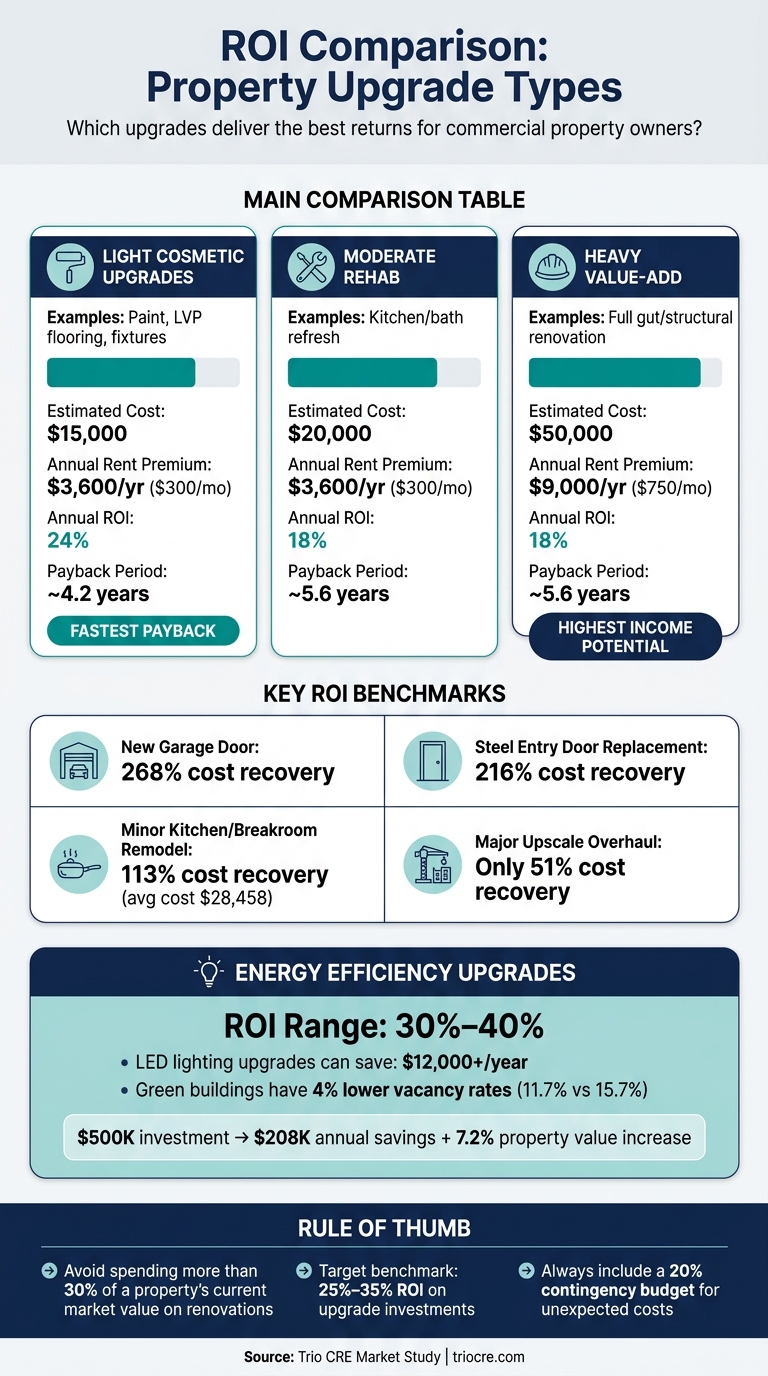
ROI Comparison: Property Upgrade Types for Commercial Real Estate
Evaluating returns upfront is crucial to avoid over-investing and to ensure the project makes financial sense.
The ROI Formula and How to Apply It
Here’s the basic formula for calculating ROI:
ROI (%) = (Net Profit from Upgrade ÷ Upgrade Cost) × 100
In real estate, this is often referred to as Return on Cost, which measures how much extra annual rent an upgrade generates compared to the money spent on it. For example, if you invest $20,000 to refresh a kitchen and bathroom and it adds $300 per month in rent, the annual ROI stands at 18%.
Another important measure is Forced Equity, which calculates how much value a renovation adds to a property. The formula is:
After-Repair Value (ARV) - Purchase Price - Renovation Costs.
Take this scenario from November 2025: An investor in Memphis bought a duplex for $180,000, spent $40,000 on upgrades (kitchen, bath, and flooring), and saw the property appraised at $260,000. This created $40,000 in forced equity and an 18.2% return on the total capital of $220,000.
Ava Taylor, a Market Research Analyst at REI Prime, emphasizes:
"The formula tells you what's possible. The details tell you what's realistic. Run the numbers before you fall in love with the property."
When budgeting, always include a 20% contingency for unexpected issues such as outdated wiring, water damage, or plumbing problems. Also, keep in mind that material costs have risen by 15–25% since 2020, so padding your estimates is more important than ever.
These calculations help you weigh the ROI of different types of upgrades.
ROI Comparison Across Upgrade Types
The table below breaks down typical upgrade categories by cost, rent increase, ROI, and payback period:
| Upgrade Category | Estimated Cost | Annual Rent Premium | Annual ROI % | Payback Period |
|---|---|---|---|---|
| Light Cosmetic (paint, LVP flooring, fixtures) | $15,000 | $3,600 ($300/mo) | 24% | ~4.2 years |
| Moderate Rehab (kitchen/bath refresh) | $20,000 | $3,600 ($300/mo) | 18% | ~5.6 years |
| Heavy Value-Add (full gut/structural) | $50,000 | $9,000 ($750/mo) | 18% | ~5.6 years |
ROI % is calculated as (Annual Rent Premium ÷ Estimated Cost) × 100.
This comparison helps property owners decide which upgrades align with market demand and offer the best returns. Light cosmetic work provides the quickest payback at about 4.2 years, while more extensive renovations take longer to recoup costs but can lead to higher overall income. Most commercial investors aim for a 25%–35% return on their upgrade investments as a benchmark for success. If your project doesn’t meet that range, it might be time to rethink the scope - or even the property.
Justin Goodin from CRE Daily advises:
"If the property is not able to generate a sufficient ROI, based on the planned renovation cost, it may not make financial sense to spend that much capital on the project."
As a general rule, avoid spending more than 30% of a property’s current market value on renovations. Going beyond that risks over-improving, which the local market may not support.
How Trio CRE Helps Property Owners Maximize Upgrade ROI

Getting the numbers right on ROI is just the beginning. To truly maximize returns, the choice and order of upgrades matter. Trio CRE provides Oklahoma commercial property owners with the strategic insight needed to make these decisions.
Data-Driven Recommendations for Property Value
Trio CRE starts by focusing on operational improvements that boost performance before jumping into physical upgrades. The process begins with an operational audit, which includes comparing current rents to market averages, reviewing insurance and property tax assessments, and identifying ways to cut expenses without investing additional capital. For instance, adopting a Ratio Utility Billing System (RUBS) shifts utility costs like water, sewer, and trash to tenants, increasing NOI without requiring renovations.
Here’s an example: closing a $100 per unit rent gap on a 16-unit building adds $19,200 in annual income. At a 7% cap rate, this translates into over $600,000 in added property value. To tailor strategies, Trio CRE leverages local market data, including demographic trends, supply and demand, and growth patterns.
Once these operational efficiencies are in place, Trio CRE moves to physical upgrades. They prioritize light cosmetic updates (Tier 2) before tackling more extensive renovations (Tier 3). Light cosmetic work can deliver around 200% ROI over five years, while full gut renovations typically yield 120–150% ROI with a payback period of 44 months.
After capturing these immediate gains, the focus shifts to ensuring long-term success through strategic asset management.
Long-Term Asset Management for Better Performance
Sustaining property performance over the long haul requires ongoing asset management. Trio CRE offers services that combine financial oversight, proactive maintenance, and tenant mix optimization to maintain strong performance well beyond the initial upgrade phase.
By carefully screening tenants, Trio CRE builds a balanced mix that reduces turnover and speeds up leasing. This approach supports stable NOI and ensures properties remain competitive. Properties with a curated tenant mix and diverse amenities see 12% higher tenant demand compared to more generic offerings.
Tenant engagement surveys also play a key role, helping identify which amenities - like shared lounges, wellness spaces, or advanced tech infrastructure - will resonate most with residents. Adding the right tenant-focused amenities can boost retention rates by as much as 22% within a year.
Conclusion
The study highlights that successful property upgrades rely on data-driven, market-aware strategies. The findings are clear: exterior improvements consistently outperform optional interior remodels, energy-efficient updates cut operating costs while increasing NOI, and tenant-focused amenities enhance both retention and long-term asset value.
Here are some key takeaways: modernizing lobbies and installing LED lighting can lead to a 20% rent increase within a year, while offering a diverse mix of amenities boosts tenant demand by 12% compared to more basic options.
This evidence reinforces the importance of making targeted, strategic upgrades.
"Strategic commercial real estate improvements are more than just property upgrades; they're an investment in tenant retention and asset performance." - Grace Hill
An effective upgrade plan starts with improving operational efficiency, followed by high-ROI exterior and cosmetic enhancements. The final step is investing in amenities that directly address tenant needs. Skipping or mismanaging these phases can significantly impact returns.
For property owners in Oklahoma, Trio CRE offers a data-driven approach to designing upgrade strategies tailored to the local market.
FAQs
Which upgrades raise rents the fastest?
Exterior improvements such as replacing garage doors, steel entry doors, and adding manufactured stone veneer can significantly boost rental income. The 2025 Zonda Cost vs. Value Report highlights their impressive return on investment: garage door replacements recoup 268% of their cost, steel entry doors 216%, and stone veneer 206%. These upgrades not only enhance property value but also make a noticeable impact on rental potential.
How do I estimate ROI before renovating?
To get a sense of ROI before starting renovations, weigh the costs of the project against the potential financial gains. These could include a higher property value, increased rental income, or a boost to net operating income. Tools like ROI calculators can simplify this process, while a thorough cost-benefit analysis can help you forecast returns. Having a well-thought-out renovation plan can also pinpoint which upgrades will add the most value and confirm that the investment is worth the expense.
When does a renovation become over-improving?
When a renovation surpasses the typical standards or expectations of the neighborhood, it’s often labeled as over-improving. This happens when the cost of upgrades doesn't translate into a comparable boost in property value or rental income, potentially leading to a lower return on investment (ROI).