Site Selection Factors for Oklahoma Properties
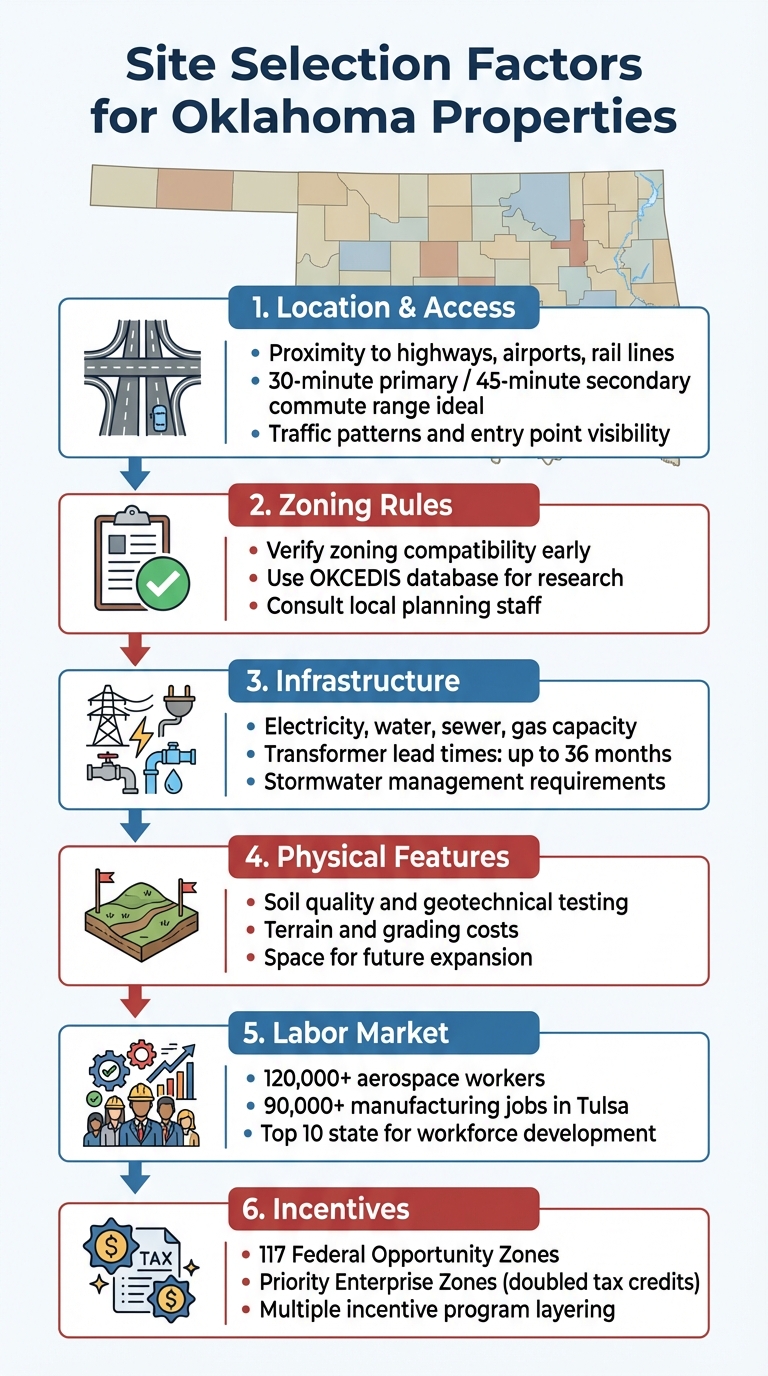
Choosing the right property in Oklahoma can save costs, improve operations, and unlock financial perks like tax incentives and workforce benefits. Here's a quick breakdown of what to consider:
- Location & Access: Proximity to highways, airports, and rail lines boosts logistics and employee convenience. Traffic flow and visibility impact customer access and safety.
- Zoning Rules: Verify zoning compatibility early to avoid delays. Use tools like OKCEDIS and consult local planning staff for guidance.
- Infrastructure: Reliable utilities (electricity, water, sewer, gas) are critical. Assess capacity and lead times for connections.
- Physical Features: Soil quality, terrain, and growth space influence construction costs. Conduct geotechnical tests and land surveys.
- Labor Market: Oklahoma offers a skilled workforce in industries like aerospace and manufacturing, coupled with a low cost of living.
- Incentives: Explore Opportunity Zones, Priority Enterprise Zones, and other programs to maximize tax benefits.
Proper planning ensures your site aligns with operational needs while leveraging Oklahoma's business-friendly environment.
6 Essential Site Selection Factors for Oklahoma Commercial Properties
The Art of Site Selection: Key Considerations for Business Growth
Location and Access
Transportation connectivity is a key factor in determining how smoothly your property can operate and whether customers and employees can conveniently reach you. In Oklahoma, being close to major highways, airports, and rail lines can significantly lower shipping costs and speed up delivery times. This is particularly important for businesses in distribution and manufacturing sectors. Let’s break down the specifics of transit routes and traffic considerations.
Distance to Highways, Airports, and Rail
Access to interstates can make a big difference in logistics efficiency and employee satisfaction. Properties near major highways allow for quicker distribution and easier commutes, which can help retain talent. Ideally, your site should fall within a 30-minute primary or 45-minute secondary commuting range to maintain a strong pool of applicants.
For industries like aviation, aerospace, or metal fabrication, being near airports and intermodal facilities is a game-changer. These connections provide the global reach that larger companies often need. Additionally, Oklahoma City's BNSF rail routes offer direct freight access, which can help businesses save on transportation expenses.
Traffic Patterns and Entry Points
Proximity to major routes is only part of the equation; how traffic flows in and out of your property also matters. Daily traffic patterns and the design of access points directly impact customer convenience and employee safety. For high-traffic areas, signalized intersections can make entry and exit smoother, while restricted access points may frustrate customers and reduce foot traffic.
Traffic counts in Oklahoma vary widely. Main streets average about 5,500 vehicles per day, but there are significant differences - Bethany sees 17,400 daily vehicles, while Pauls Valley experiences just 778. When assessing traffic counts, focus on "vehicles per lane" rather than total volume. For instance, a two-lane road with 7,000 vehicles per lane can handle traffic better than a four-lane road averaging 570 per lane.
Visibility and road frontage are crucial for attracting customers. Properties with clear sightlines from major roads often draw more attention, while hidden locations may struggle - even in the absence of nearby competition. If foot traffic is important to your business, check that lane widths and crossing distances won’t deter pedestrians. Oklahoma’s roads often have wider lanes (sometimes 20 feet compared to the standard 10–12 feet), which can make crossing on foot more challenging.
These factors play an essential role in evaluating properties in Oklahoma, complementing considerations like zoning, infrastructure, and economic conditions, which will be discussed later.
Zoning and Land Use Rules
Before diving into a new investment, make sure local zoning regulations align with your intended use. Even the most promising location can turn into a headache if zoning restrictions conflict with your plans. Taking the time to understand zoning requirements and the permitting process during your initial research can help you avoid costly delays. Once you’ve confirmed zoning compatibility, the next step is tackling the permitting process.
Oklahoma Zoning Requirements
Zoning rules are a critical piece of the puzzle when evaluating a site. Start by verifying the property’s zoning designation to ensure your planned use is allowed. You’ll also want to check for any land use designations, floodplain restrictions, or subdivision regulations that might apply. This step is essential before entering into any agreements.
It’s a good idea to consult with local planning staff to determine whether your project can proceed “by right” or if it requires a re-zoning, variance, or special exception. Tools like the OKCEDIS database can help you review site regulations and explore Certified Sites. Additionally, the Greater Oklahoma City Partnership offers support to simplify your evaluation process. Regional economic development groups can also assist in navigating permits and regulations, while helping you understand how specific sites might align with incentive programs or workforce training benefits.
Once you’ve confirmed zoning compatibility, you’re ready to move on to the permitting phase.
Permits and Expedited Approval Options
After verifying zoning alignment, the next step is to begin the formal permitting process. This involves submitting applications, paying fees, and providing technical documents like site plans and plats. Public notification is part of the process too - your request will be mailed to nearby property owners (within 300 feet), published in a local newspaper, and posted online.
For larger or more complex projects, a Pre-Development Meeting might be required, which includes early communication with neighbors. For instance, Tulsa’s Section 70.010-E of the Zoning Code specifies that you must document your neighbor outreach efforts and submit a summary before the first public hearing.
Public hearings, typically held by the Planning Commission or Board of Adjustment, are another key step. During these hearings, you’ll need to present a concise (3-5 minute) summary of your project. Avoid mentioning financial details, as these are not considered by the boards. If the Planning Commission approves your re-zoning request, it will move to the City Council for final approval. If the Board of Adjustment denies your application, you can appeal the decision in District Court.
To save time, consider partnering with regional economic development professionals. They can guide you through programs like the Strategic Investment Program (SIP) and Emerging Technology Fund (ETF), working in tandem with the Oklahoma City Economic Development Trust. For additional guidance, local experts at Trio CRE are available to assist with zoning and permitting challenges.
Infrastructure and Utilities
For commercial sites in Oklahoma, having dependable access to electricity, water, sewer, and natural gas is critical for smooth operations. Often, the availability and capacity of these utilities determine whether a site is suitable for your business and how quickly construction can begin.
Water, Sewer, Electricity, and Gas
Start by assessing the operational capacity of existing utility lines. For industries like data centers or manufacturing facilities that consume significant amounts of power, reliable electricity is often the top priority - sometimes even more important than land costs. Delays in securing essential electrical components can be substantial, with lead times for transformers stretching up to 36 months. In some cases, large-scale manufacturers may face up to five years before connecting to the grid.
"To find a site for a large manufacturing facility that has sufficient energy, especially electricity, is a big challenge... Lead time on transformers is up to 36 months." - Dennis Cuneo, Partner, Fisher Phillips
Utility providers such as Oklahoma Gas & Electric (OG&E) can assist with rate analysis, billing estimates, and capacity planning to help avoid unexpected expenses. A notable example of successful collaboration is Mom's Meals, which partnered with OG&E and the Greater Oklahoma City Chamber in 2021 to establish a 200,000-square-foot food preparation kitchen, creating approximately 550 new jobs. Similarly, Dollar General worked closely with the Ardmore Development Authority to open a new distribution center in Ardmore, supporting 800 total jobs.
Apart from electricity, it’s essential to ensure the water and sewer systems can handle your operation's needs. Hiring a civil engineer can help estimate site preparation costs, including utility connections and land grading. Tools like the LOIS location analysis tool can also verify existing infrastructure. Additionally, Oklahoma's SITES Program (Supporting Industrial Transformation and Economic Success) focuses on "last mile" infrastructure projects, ensuring that sites are equipped with the necessary utilities to compete on a national level.
Once utility capacity is confirmed, the next step is to address stormwater management and wetland considerations.
Drainage Systems and Wetland Areas
Stormwater and wetland regulations can heavily influence both the timeline and cost of your project. If your development disturbs one or more acres of land, you’ll need OKR10 Construction General Permit coverage from the Oklahoma Department of Environmental Quality (ODEQ). This includes creating a detailed Stormwater Pollution Prevention Plan (SWP3) to manage sediment, debris, and chemicals during construction.
For sites considered "High Priority" - those impacting over 40 acres or located within one mile of sensitive or impaired waters - stricter rules apply. These include maintaining a 100-foot vegetated buffer from streams (in contrast to the standard 50-foot buffer) and installing sediment basins for projects disturbing as little as five acres. To determine if your site falls under these regulations, use tools like ODEQ’s GIS or EPA’s Waterbody reports.
Cities like Oklahoma City and Tulsa have additional requirements under their Municipal Separate Storm Sewer System (MS4) permits. These may include extra erosion control measures or SWP3 reviews during the permitting process. If your property contains a stream, pond, or lake, it’s also wise to confirm water rights for irrigation or recreational purposes before finalizing the purchase.
For tailored advice on navigating Oklahoma’s utility and environmental regulations, partnering with local experts like Trio CRE can simplify the process. Their expertise in the Oklahoma market can help ensure your site meets both operational demands and regulatory standards.
Physical Site Features
Before starting any commercial development in Oklahoma, it's important to understand the physical characteristics of your site. Oklahoma's diverse geography means significant differences in soil types and terrain, which can impact construction costs and long-term stability. Below, we break down key soil evaluation methods and terrain considerations to help you avoid potential challenges.
Soil Quality and Ground Testing
Oklahoma's soils vary widely - from the expansive red clays found in areas like Oklahoma City and Edmond to the sandy loams common in rural parts of the state. Red clay soils, in particular, are known for their tendency to swell and shrink, which can lead to foundation movement and cracking if not properly addressed. This makes geotechnical analysis an essential step before purchasing or developing land.
Core sampling is a critical tool for evaluating the soil's load-bearing capacity and identifying potential issues, such as high plasticity or groundwater concerns. In areas with reactive clay, engineers might recommend using post-tension slabs to prevent settling. Proper grading is also crucial - ensuring a slope of at least six inches over the first ten feet away from the foundation helps manage water runoff effectively.
"A dream home is only as strong as the ground it's built on. We see the relief on our clients' faces when they realize we've handled the complexities of the site work." - Bono, Project Manager, ACET Custom Homes
In addition to soil testing, it’s essential to call Oklahoma 811 at least three days before any excavation work to locate underground utilities. For sites with potential contamination risks - such as old oil wells, pesticide residues, or acid mine drainage - a Phase I Environmental Site Assessment (ESA) is recommended. If any red flags surface, a Phase II ESA involving physical soil testing may be necessary.
Once the soil's stability is confirmed, the next step is to analyze the site's dimensions and terrain to ensure it meets your development needs.
Site Dimensions, Terrain, and Growth Space
After addressing soil concerns, the site's topography and dimensions play a major role in determining construction feasibility and future growth potential. Land that requires extensive leveling or grading can significantly increase upfront costs, especially in rugged areas like the Ouachita and Wichita mountains. On the other hand, flatter regions such as the Red Beds Plains are generally more cost-effective to prepare and offer better opportunities for expansion.
When assessing dimensions, confirm there’s enough space for your planned structures, parking areas, and access routes. It’s also wise to consider future expansion needs - choosing a site with extra room for growth is far less costly than relocating later. To simplify the process, the Greater Oklahoma City Partnership provides Certified Sites with GIS-integrated listings that have already been vetted for physical suitability and infrastructure.
Additionally, hiring a certified arborist can help identify valuable trees, such as native oaks or elms, which not only enhance property value but may also require protection during construction. A professional land survey is another must-have - it can uncover unrecorded utility easements or rights-of-way that might restrict your building plans. Bringing a civil engineer into the planning process early on will help you estimate site preparation costs and navigate Oklahoma's unique physical challenges.
These detailed physical assessments, combined with zoning, infrastructure, and economic evaluations, provide a clearer picture of a site's overall potential.
Labor Market and Economic Conditions
Once a site's physical suitability is confirmed, it's crucial to evaluate Oklahoma's labor market and overall economic landscape. The state offers a skilled workforce and a cost-efficient environment, which can provide major operational advantages.
Workforce Supply and Skill Levels in Oklahoma
Oklahoma consistently ranks as a leader in workforce development. According to Site Selection magazine's 2026 rankings, the state is among the Top 10 for workforce development, highlighting its focus on preparing workers with job-ready skills through measurable outcomes like credential attainment and technical expertise. This approach prioritizes tangible results over mere program participation.
Key industries such as aerospace and manufacturing form the backbone of Oklahoma's economy. The aerospace sector alone employs over 120,000 people across more than 1,100 businesses, while Tulsa has established itself as a manufacturing powerhouse, supporting more than 90,000 jobs. Even when companies relocate corporate headquarters, like Expand Energy’s move to Houston in early 2026, Oklahoma City remains a reliable hub for energy and industrial operations. These strengths in workforce readiness and industry stability align seamlessly with the state’s favorable economic environment.
Living Costs, Population Data, and Business Environment
Oklahoma's economic appeal extends beyond its workforce. The state offers a cost-effective, high-quality lifestyle that benefits both businesses and their employees. In 2025, Oklahoma City ranked first for cost of living among cities with populations over 100,000 and also led in quality of life for cities with populations exceeding 500,000. This affordability allows companies to attract and retain talent without the need for higher salary premiums often required in pricier markets.
By 2024, Oklahoma's population was estimated at 4,088,380, with Oklahoma City and Tulsa serving as key commercial centers, housing 709,330 and 411,308 residents, respectively. Real estate also plays a pivotal role in the state’s economy, contributing $23.17 billion in 2024 - outpacing even the oil and gas sectors. As Kimberly Robbins, Board President of the Oklahoma City Metropolitan Association of REALTORS, explained:
"Real estate is the foundation that allows it all to happen. When businesses expand, when new industries invest in the state, and when communities grow, real estate is the foundation".
Oklahoma’s business-friendly environment is further bolstered by its Top 5 corporate tax climate ranking in 2025. The state continues to attract substantial investments, such as Sofidel Group’s $775 million expansion of its Inola facility in March 2026, and NorSun’s commitment to create 320 jobs in Tulsa in July 2025. These developments highlight confidence in Oklahoma’s long-term business potential and workforce reliability.
With its advantageous combination of location, zoning, infrastructure, and economic strengths, Oklahoma stands out as a prime destination for commercial development.
Environmental and Regulatory Requirements
When planning a commercial purchase or development in Oklahoma, ensuring compliance with environmental standards is a critical step. These precautions help protect against future liabilities, keep your project aligned with state and federal laws, and prevent costly delays or legal issues.
Environmental Testing for Pollution
Environmental assessments are key to identifying contamination risks that might impact your investment. For example, the Oklahoma Department of Transportation (ODOT) conducts reviews for Recognized Environmental Conditions (RECs), such as leaks from underground storage tanks, within a 0.5-mile radius of the site. If your project involves federal funding, compliance with the National Environmental Policy Act (NEPA) is required. This includes ODOT evaluations of wetlands, floodplains, and protected species. Additionally, construction near streams or wetlands may require a Clean Water Act Section 404 permit. These pollution assessments also tie into how specific Department of Transportation (DOT) rules could affect your project.
DOT Rules and Traffic Impact Studies
ODOT regulations play a significant role in site approval and access. For properties near public parks, trails, or wildlife refuges, Section 4(f) of the Transportation Act of 1966 applies. ODOT explains:
"Section 4(f) of the Department of Transportation Act of 1966 (49 U.S.C. 303) affords protection to publicly owned recreation areas (resources) including city, state and national parks, wildlife refuges, management areas and historic sites".
Projects impacting these protected areas require coordination with ODOT. While some, like "Type III" projects, are exempt from traffic noise studies, others may require these studies and mitigation strategies. If your site includes potential habitats for endangered species - such as the northern long-eared bat or the American burying beetle - ODOT enforces measures to reduce environmental impacts. Conducting early biological surveys can help identify active habitats that might delay construction. Additionally, sites with archaeological or historical importance could trigger detailed Section 106 consultations unless they qualify for a "Screened Exemption".
Oklahoma Site Evaluation Resources
Oklahoma provides a range of state-managed tools designed to simplify the process of evaluating commercial properties. These resources combine property listings with detailed incentive information, enabling quicker and more informed decision-making. They don’t just streamline property searches - they also deliver essential data on factors like location and economic benefits to guide your choices.
LocateOK Property Database
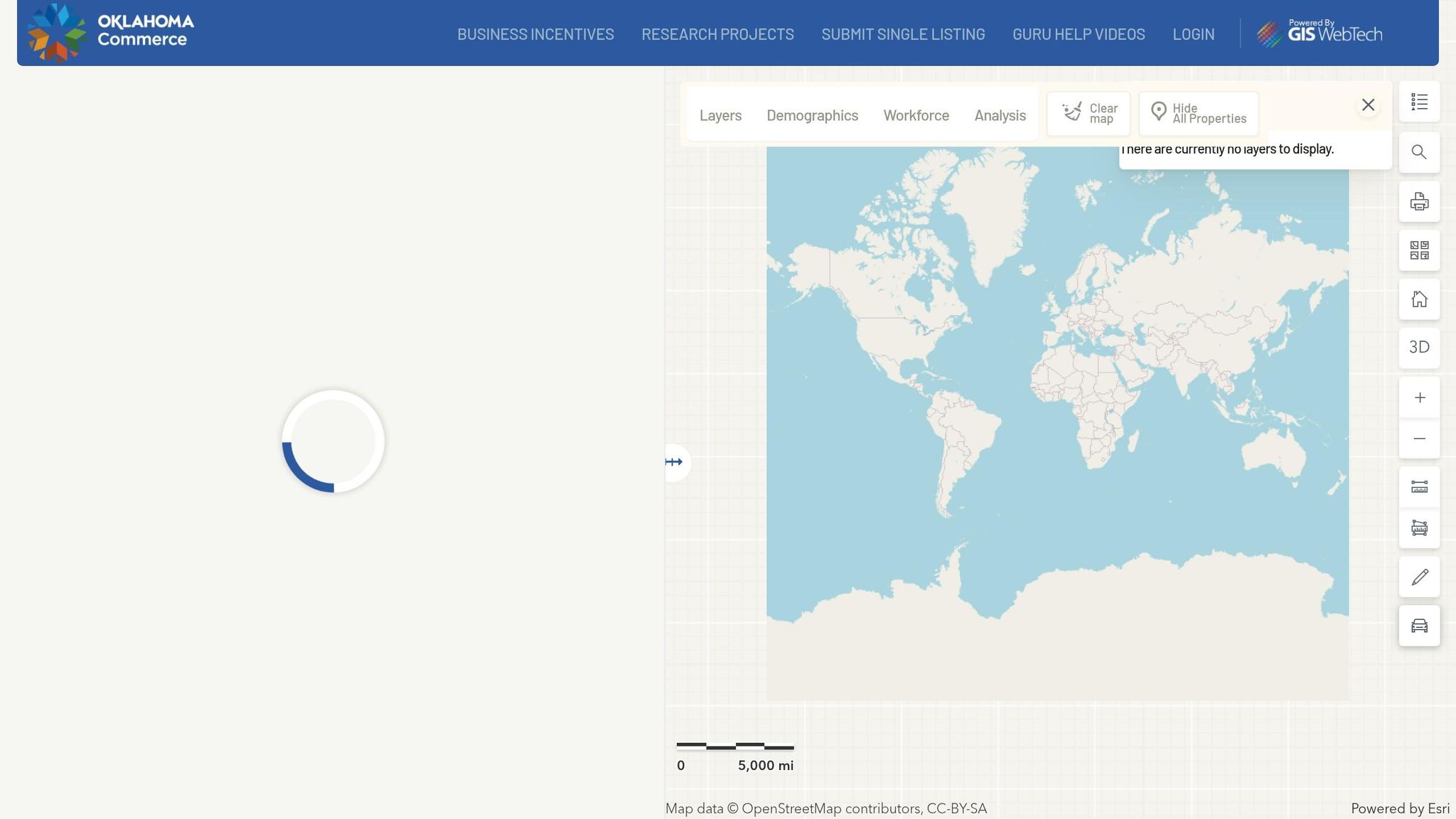
LocateOK.com is Oklahoma’s go-to platform for finding commercial properties, offering a comprehensive database of buildings and land throughout the state. You can refine your search by property type, size, and location, and access valuable details like labor demographics, wage levels, and proximity to infrastructure. Listings often include photos and downloadable brochures for easy reference.
For more advanced insights, the Oklahoma Department of Commerce Interactive Maps offer GIS-based tools to identify incentive zones such as Enterprise Zones, Quality Jobs Program 5% Areas, Former American Indian Lands, and Federal Opportunity Zones. Additionally, the CDBG Awards Map highlights Community Development Block Grant projects, helping you identify areas with significant public investment.
The Tulsa Region Prospector is another powerful tool, providing regional economic development maps with layers that cover broadband infrastructure (projected through 2025), energy access, environmental considerations, and tools for comparing communities. This system also connects users with Regional Development Specialists who offer localized referrals and program support.
Alongside property data, Oklahoma’s tax incentive programs add another layer of value to site evaluation.
Tax Incentive Zones and Opportunity Areas
Tax incentives play a key role in assessing the long-term financial benefits of a property. Currently, Oklahoma has 117 Census tracts designated as Federal Opportunity Zones, where investors can defer and reduce federal capital gains taxes by investing through Qualified Opportunity Funds. Looking ahead, the state is transitioning to Opportunity Zone 2.0, a permanent program set to begin on January 1, 2027. Under this initiative, the Governor can nominate up to 25% of eligible Census tracts for 10-year designations, with public input being collected through surveys in March and April 2026 to help identify these areas.
Priority Enterprise Zones (PEZs) offer even greater advantages. These zones provide doubled corporate income tax credits for new investments or job creation, and their designation lasts for the full duration of the Opportunity Zone tract. PEZ status also helps classify areas as distressed, making them easier to include in Tax Increment Financing (TIF) districts for redevelopment. According to the Oklahoma Department of Commerce:
"Investors who take advantage of Oklahoma's Federal Opportunity Zones within PEZs can potentially layer other state and/or local incentives".
When evaluating properties, focus on locations where multiple incentive programs overlap. For instance, a property situated in both an Opportunity Zone and a PEZ allows you to combine federal tax benefits with enhanced state-level Investment Tax Credits. Property owners can also submit investment opportunities directly to the Department of Commerce for inclusion in investor-facing listings. Oklahoma’s "rolling conformity" with Federal Adjusted Gross Income further simplifies the process of applying for tax benefits.
Conclusion
Choosing the right commercial property in Oklahoma has a direct impact on your initial costs, operational efficiency, and long-term investment value. Matt Marsh of Marsh & Partners emphasizes this point:
Finding a site in the path of development growth can make the buying and development process simpler.
A well-chosen property can act as a strategic tool for business growth. The ideal site will align with your goals for attracting talent, improving employee retention through accessible locations, and positioning your business in Oklahoma's key growth areas. It's also crucial to confirm zoning compatibility early on, as rezoning can be both time-consuming and costly, potentially delaying your entire project.
Taking the time to evaluate factors like site access, utility capacity, and room for future expansion can save you from unexpected expenses down the road. These early assessments are essential for staying on budget and ensuring your site meets your long-term needs.
To navigate the complexities of site selection, consider partnering with experienced local professionals. Organizations like the Greater Oklahoma City Partnership can assist with workforce analysis, permitting guidance, and navigating incentive programs. Their expertise can also help you identify properties that qualify for overlapping tax incentives, such as those located in both Opportunity Zones and Priority Enterprise Zones, maximizing your financial advantages.
Trio CRE offers a full range of commercial real estate services across Oklahoma, including site selection, land development, and asset management. Their team provides customized solutions to match property choices with your business objectives. They can help you navigate zoning regulations, evaluate infrastructure readiness, and enhance the long-term potential of your property. With their in-depth local market knowledge and data-driven insights, Trio CRE can also guide you through Oklahoma's incentive programs and identify sites primed for growth. By combining strategic planning with local expertise, your commercial project is well-positioned to thrive in Oklahoma’s evolving market.
FAQs
How do I confirm a site’s zoning will allow my business use?
To determine if a site's zoning allows for your business use, you can request a Zoning Verification Letter from the local municipality. If the situation is more complicated, consider obtaining professional zoning reports. These reports offer detailed insights, helping you ensure your plans align with zoning regulations and meet any lender requirements. They can also highlight potential zoning risks, giving you the information needed to make well-informed decisions about your property.
What utility capacity checks should I do before buying a site?
Before buying a site, take the time to assess its utility capacity. Look into the availability and adequacy of energy, water, and telecommunications services. It's important to confirm that the existing infrastructure can handle your requirements. To get accurate information, consult local authorities like the Oklahoma Corporation Commission. This step helps ensure the site can support your plans and prevents unexpected service limitations down the line.
Which Oklahoma incentives could apply to my property?
Oklahoma offers several programs to attract and support businesses, including the Quality Jobs Program and the Small Employer Quality Jobs Program, along with a range of tax credits and exemptions. Among these are ad valorem exemptions, which apply to specific types of eligible property. For detailed information on guidelines and eligibility, it's best to refer to state-provided resources.