
Septic Systems For Mixed-Use Properties: Key Rules
In Oklahoma, septic systems are critical for mixed-use properties, combining residential and commercial spaces. Proper design, installation, and maintenance are essential to avoid failures, health risks, and regulatory penalties. Here’s what you need to know:
- Sizing Matters: Systems must be designed based on the number of bedrooms and daily water usage, as required by Oklahoma law (§ 2-6-403).
- Regulations: Title 252, Chapter 641 governs septic systems. Lot size, soil testing, and proximity to protected water bodies determine system requirements.
- Certified Installers: Starting November 1, 2025, only DEQ-certified installers can handle multiple projects annually. Non-certified installers are limited to one system per year.
- Soil and Site Testing: Soil type and terrain impact system design. Advanced systems like Aerobic Treatment Units (ATUs) may be required for challenging conditions.
- Permits: A DEQ permit process includes soil testing, construction authorization, and final inspection.
- Maintenance: Regular pumping and proper usage are vital. Failure to maintain systems can lead to fines and costly repairs.
Regulatory Requirements in Oklahoma
Key Rules from Oklahoma DEQ Chapter 641
In Oklahoma, private wastewater systems fall under the regulations of Title 252, Chapter 641 of the Oklahoma Administrative Code. Officially titled "Individual and Small Public On-Site Treatment Systems", this set of rules plays a major role for mixed-use properties. Changes in a building's use - like adding bedrooms or increasing water usage - can often trigger the need for a new permit.
Lot size is a critical factor. Properties with access to public water must be at least 0.5 acres, while those using a private well require a minimum of 0.75 acres. Additionally, you must set aside 10,000 square feet (roughly 0.25 acres) for the septic system. If your property is within 300 feet of a designated impaired reservoir or stream, advanced nitrogen-reducing components are mandatory under the Water Body Protection Area (WBPA) rules. To avoid surprises, confirm your property’s WBPA status early by consulting the local DEQ office. The next section explains how SB 111 changes the landscape for septic system installation.
How SB 111 Affects Septic System Installers
Starting November 1, 2025, SB 111 introduces clear distinctions between certified and non-certified septic system installers in Oklahoma. Non-certified installers are limited to just one project per year, and their work must be inspected by DEQ personnel before any backfilling occurs - potentially causing delays. On the other hand, DEQ-certified installers have no annual limits and can perform self-inspections, which helps projects move along more efficiently.
Here’s a quick comparison:
| Installer Type | Annual Installation Limit | Inspection Requirement |
|---|---|---|
| DEQ-Certified Installer | No limit | Authorized to perform self-inspections |
| Non-Certified Installer | 1 system per year | DEQ inspection required before backfilling |
To avoid project delays, check the DEQ's "Active Certified Installers" list before hiring. This is especially important for mixed-use properties, where delays can disrupt both residential and business activities.
Site Suitability and Design for Mixed-Use Properties
Site Constraints and Soil Testing
Before designing a septic system, it's crucial to assess the land's suitability. The Oklahoma DEQ categorizes soils into five texture groups, each with unique implications for wastewater treatment. For example, Group 1 soils, like coarse sand, allow water to percolate so quickly that untreated wastewater might reach groundwater. On the other hand, Group 5 soils, made up of clay and silty clay, hold onto water so tightly that wastewater can surface, making standard systems ineffective.
"Fine-textured soils may cause wastewater to pond over a subsurface application location that could eventually break through the soil surface ('surfacing'). Conversely, coarse-textured soils allow wastewater to flow through the soil profile rather quickly and could recharge the groundwater without effective treatment." - Sergio M. Abit Jr., Extension Specialist for Soils
To identify these challenges, a soil profile is examined by analyzing texture and color at 6-inch intervals, typically down to 48–54 inches. This process is especially important for properties near scenic rivers or within designated Water Body Protection Areas. Conventional systems work best on relatively flat terrain, while Low-Pressure Dosing (LPD) systems are better suited for slopes ranging from 2% to 10%. Flood-prone or ponding areas should be avoided during the design phase.
By addressing these soil and site constraints, you can ensure proper system design and streamline the permitting process.
Calculating System Capacity for Mixed-Use Wastewater Loads
Mixed-use properties generate wastewater from diverse sources like residential units, offices, retail spaces, and food services. Because of this, relying solely on the number of bedrooms to size a system is inadequate. Instead, commercial wastewater capacity is calculated using daily flow rates. The DEQ provides a "Report for On-Site Sewage" (Form 581), which outlines minimum dispersal requirements based on these rates. Accurate calculations are essential, especially when future expansions or changes in usage could increase water demands. If water consumption rises due to renovations or shifts in building use, a Modification Authorization must be obtained before any adjustments are made.
For properties with challenging soil conditions, such as shallow bedrock, clay-heavy soils, or a high water table, an Aerobic Treatment Unit (ATU) might be the best solution. ATUs have been increasingly popular in Oklahoma since 2013 for their ability to function where conventional systems fall short. However, they come with higher costs - typically $5,500–$6,000 for a three-bedroom home with spray irrigation, compared to $3,000–$4,000 for a standard system. For mixed-use properties with higher wastewater volumes, the expenses can be even greater. Additionally, ATUs require electricity and regular professional maintenance, which adds to their long-term operating costs.
Careful capacity planning ensures compliance with permitting requirements and prepares the system for future needs.
Overview of the Math, Design, and Build of a Septic System
Permits and Certifications for Septic Systems in Oklahoma
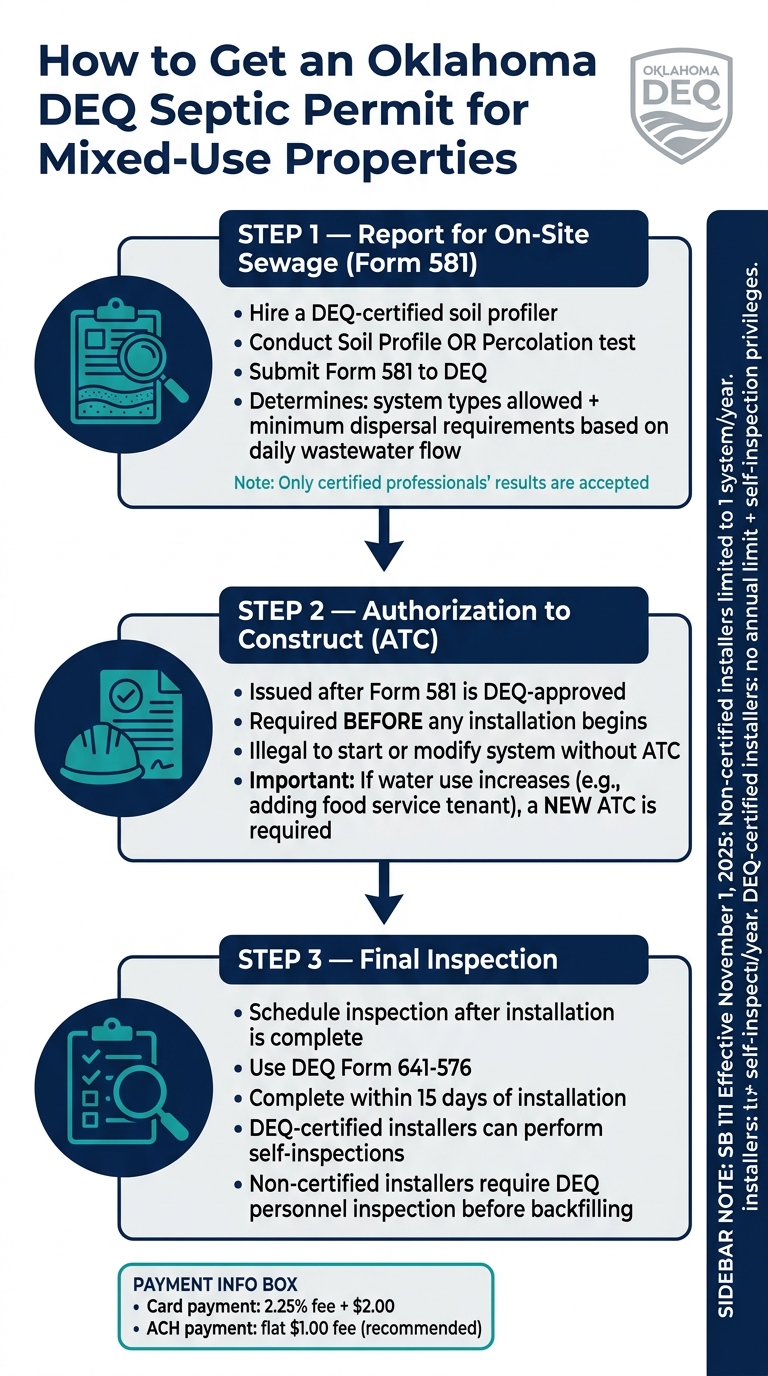
Oklahoma Septic Permit Process for Mixed-Use Properties
How to Get a DEQ On-Site Sewage Permit
In Oklahoma, mixed-use septic permits are issued under Title 252:641, based on daily wastewater flow. The process involves three key steps:
- Report for On-Site Sewage (Form 581) Start by having a DEQ-certified soil profiler conduct a soil test - either a Soil Profile or Percolation test. Only results from certified professionals are accepted, so it’s crucial to verify their credentials beforehand. Once the test is complete, submit Form 581. This form determines the types of systems allowed and sets minimum dispersal requirements based on your property’s daily wastewater flow.
- Authorization to Construct (ATC) After Form 581 is approved by the DEQ, you’ll need to obtain an ATC before beginning any installation work. It’s illegal to start or modify a system without this authorization. If your property’s water use increases - like adding a food service tenant to a retail space - you’ll need a new ATC before making any system adjustments.
- Final Inspection Once installation is complete, schedule a final inspection. Ideally, this should be done through a DEQ-certified installer using Form 641-576. To avoid delays, complete the inspection within 15 days. Working with certified professionals ensures a smoother process and helps maintain compliance.
For payment, DEQ charges a 2.25% fee plus $2.00 for card transactions. Using ACH is more cost-effective, with a flat fee of $1.00.
Lastly, ensure that everyone involved in the process holds the necessary DEQ certifications.
Working with DEQ-Certified Installers and Pumpers
Oklahoma requires specific certifications for various roles in septic system installation and maintenance. Below is a quick overview:
| Professional Role | Required Certification | Governing Body |
|---|---|---|
| System Installer | DEQ Certified Installer (by system type) | Oklahoma DEQ |
| Septage Pumper | DEQ Licensed Septage Pumper and Transporter | Oklahoma DEQ |
| Soil Tester (Profile) | DEQ Certified Soil Profiler | Oklahoma DEQ |
| Percolation Tester | Registered Percolation Tester | Oklahoma Dept. of Health |
Installer certifications are system-specific, covering options like Conventional/Shallow Extended, Lagoons, Aerobic with spray irrigation, and Aerobic with drip irrigation. Always confirm that your installer is certified for the type of system your property requires.
Starting November 1, 2025, individuals without DEQ certification will be restricted to installing just one on-site sewage treatment system per year.
"Effective November 1, 2025, individuals not certified through DEQ may only install one on-site sewage treatment system per calendar year." - Oklahoma Department of Environmental Quality
Certified installers also offer an added advantage for aerobic treatment systems (ATS). In Oklahoma, these systems include a mandatory two-year maintenance period, during which the installer is required to service the system at no additional cost to the property owner. For mixed-use properties using ATS, this built-in maintenance can help balance the higher initial costs.
Maintenance and Long-Term Care for Mixed-Use Septic Systems
Property Owner Maintenance Responsibilities
For a mixed-use property, keeping a septic system functioning smoothly requires consistent upkeep. It’s up to property owners to ensure the system operates properly and to avoid expensive repairs or compliance issues.
Septic systems must not allow sewage to surface, pool, run overland, or discharge into surface waters. Key components like tanks, dispersal lines, and lagoons must remain leak-free and structurally intact. Physical security is also essential - lagoon fences need to be in good condition, and tank lids must stay securely fastened.
To manage water usage effectively on mixed-use properties, stagger high-demand activities like laundry and heavy fixture use. Avoid introducing harmful substances into the system, such as grease, wipes, and harsh chemicals. Protect the drain field by keeping heavy vehicles off it, maintaining a grass cover, and redirecting runoff to prevent oversaturation.
Pumping schedules depend on tank size and usage. For example, a 1,000-gallon tank serving four people requires pumping every 3 years, while a 1,500-gallon tank under the same conditions can go about 4 years. Mixed-use properties with higher daily water usage typically need more frequent servicing.
| Tank Size (gallons) | 4 People | 6 People | 8 People |
|---|---|---|---|
| 1,000 | 3 years | 2 years | 1 year |
| 1,250 | 3 years | 2 years | 1 year |
| 1,500 | 4 years | 3 years | 2 years |
If the system fails, immediate repairs are critical to avoid penalties from the Department of Environmental Quality (DEQ).
Financial assistance and expert advice can also play a key role in keeping systems running efficiently.
State Programs for Septic System Repairs and Upgrades
In Oklahoma, financial assistance for septic system repairs is available, though limited. Under Oklahoma Statute § 2-6-403(F), the DEQ can use non-appropriated funds to help low-income residents address issues like surfacing sewage:
"The Department is authorized to use monies other than fees or appropriated funds as such monies may be available to the Department to offer financial assistance to indigent citizens of the State of Oklahoma to reduce the incidence of surfacing sewage in the State of Oklahoma." - Oklahoma Statutes § 2-6-403
If your property is located within 300 feet of a listed reservoir or stream (classified as a Water Body Protection Area), repairs or upgrades may require nitrogen-reducing components, which can increase costs. In such cases, reaching out to your local DEQ representative early is a smart move. The DEQ also offers technical guidance to help design alternative systems when standard options aren’t feasible for a site.
One often-overlooked step is to set aside a repair area on your property. This is a designated section of land left clear of buildings or other obstructions, reserved for installing new dispersal lines if the original system fails. On mixed-use properties, where space can be limited, planning for this in advance can save you significant trouble and expense down the line.
Conclusion: Staying Compliant and Keeping Your System Running
Septic systems on mixed-use Oklahoma properties require consistent oversight. Start with soil testing, obtain the necessary permits, hire certified installers, and stay on top of regular maintenance. Ignoring these steps could result in fines ranging from $500 to $5,000 per violation.
Failing to comply comes with steep risks - both operational and financial. Complaints to the Oklahoma DEQ reveal that many system failures arise from issues like inadequate sizing, neglect, or unauthorized installations. These risks are even more pronounced on mixed-use properties, where fluctuating wastewater loads push systems to their limits.
The guidelines under Oklahoma DEQ Title 252, Chapter 641 are far from mere formalities. System malfunctions often result from a poor match between the system design and the soil conditions. To prevent these issues, it’s crucial to monitor water usage, select the right system, and work with DEQ-certified professionals.
As the DEQ underscores:
"Maintenance is the homeowner's responsibility and is the key to avoid system malfunctions and possible costly repairs."
For mixed-use property owners, this responsibility carries even more weight. Proper permits, expert installation, and routine upkeep are the cornerstones of a well-functioning septic system. Beyond meeting regulations, effective management improves property performance and value. Trio CRE provides specialized guidance for these critical infrastructure decisions, helping property owners in Oklahoma achieve the best outcomes for their investments and tenant satisfaction.
FAQs
Does my mixed-use property need a new septic permit if a tenant changes?
Yes, a new septic permit is usually needed when there’s a change in tenants. In Oklahoma, regulations require that the on-site sewage system is approved for the specific use of the property. When tenants change, this often prompts a re-evaluation and updated permit to ensure the system meets local compliance standards.
How do I estimate septic size for both residential and commercial uses?
To figure out the right septic system size in Oklahoma, start by looking at the number of bedrooms for residential properties. For commercial properties, focus on factors like water usage or occupancy levels. Proper certification and inspection play a key role in ensuring the system is sized correctly. Additionally, soil testing is essential, especially for systems that rely on soil absorption, as it helps determine the appropriate type and size. Make sure to adhere to state regulations to meet the requirements for both residential and commercial installations.
When is an aerobic treatment unit required instead of a conventional system?
In areas where the soil struggles with absorption or drainage - like those with deep or medium clay - an aerobic treatment unit becomes essential. These systems are also required when local regulations demand stricter wastewater treatment due to environmental factors or specific property uses. Be sure to check local rules to ensure you choose the right system for your property.