Rent Escalation Clauses in Build-to-Suit Leases
Rent escalation clauses are essential in long-term build-to-suit leases, ensuring rent increases are predictable for tenants and protect landlords from inflation and rising costs. These clauses define how rent adjusts over time, typically through fixed percentages, inflation-based calculations (CPI), or operating expense pass-throughs.
For tenants, understanding these clauses is critical to manage costs and avoid surprises. For landlords, they safeguard profitability. Key types include:
- Fixed Percentage Escalations: Predictable annual increases (e.g., 2–4%).
- CPI-Based Escalations: Tied to inflation but less predictable.
- Operating Expense Pass-Throughs: Tenants share increased operating costs.
- Stepped Increases: Rent rises in set amounts over time.
- Fair Market Value Adjustments: Rent resets to market rates during renewals.
In build-to-suit leases, rent often starts after construction, with costs like tenant improvements influencing the rent baseline. Negotiating caps, clear terms, and audit rights can help tenants control costs, while landlords benefit from inflation protection and stable returns.
Both parties need clear, well-defined escalation terms to avoid disputes and ensure fair outcomes.
Types of Rent Escalation Clauses
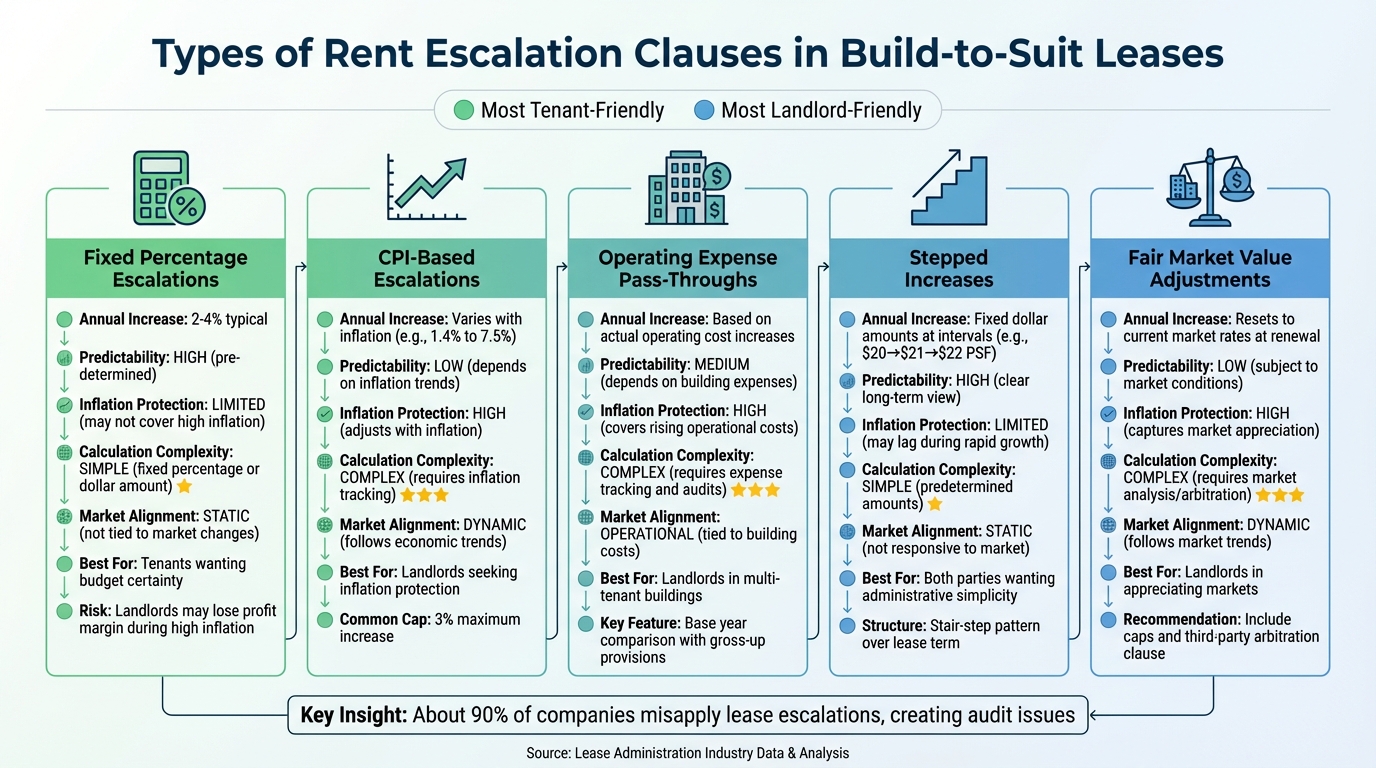
Comparison of 5 Types of Rent Escalation Clauses in Build-to-Suit Leases
Build-to-suit leases often include specific escalation clauses, each shaping how financial risks are shared between landlords and tenants over long-term agreements, typically 10 to 20 years. These clauses determine how rent adjusts based on market trends, inflation, or operational costs. Let’s dive into the most common types and how they influence negotiations.
Fixed Percentage Escalations
Fixed percentage escalations involve a set annual rent increase, often between 2% and 4%. Some leases use a flat dollar amount per square foot, such as $0.50 per square foot each year. This approach offers clear budgeting for both parties. However, landlords take on the risk that inflation could outpace the fixed increase. As Ashley S. Wagner from Tucker Arensberg points out:
"In times of high inflation, a landlord may end up losing its desired profit margin if costs have gone up and the fixed increases no longer cover those rising costs."
For tenants, especially those signing long-term leases, Casey Prindle advises:
"If you're signing a 5 or 10-year lease, make sure to calculate what your rent will look like in year 7 - not just year 1."
This method is popular in build-to-suit leases where both parties prioritize predictability over market-driven adjustments.
CPI-Based Escalations
CPI-based escalations link rent increases to the Consumer Price Index, ensuring rent aligns with inflation. This benefits landlords during periods of rising costs but can make budgeting less predictable for tenants. CPI fluctuations can be significant - for instance, the index jumped from a 1.4% increase in January 2021 to 7.5% in January 2022.
Howard Commercial describes this method as:
"Typically, a rent escalation system tied to the CPI or to another measure of inflation is considered the most landlord friendly."
To mitigate risks, many leases include caps on CPI increases, such as "CPI, not to exceed 3%." They also define parameters like the population group (CPI-U is a common choice), geographic area (e.g., U.S. City Average), and non-seasonally adjusted data to minimize complications from revisions.
| Feature | Fixed Percentage Escalation | CPI-Based Escalation |
|---|---|---|
| Predictability | High; rent is pre-determined | Low; depends on inflation trends |
| Inflation Protection | Limited; may not cover high inflation | High; adjusts with inflation |
| Ease of Calculation | Simple; fixed percentage or dollar amount | Complex; requires inflation tracking |
| Market Alignment | Static; not tied to market changes | Dynamic; follows economic trends |
Operating Expense Pass-Throughs
Operating expense pass-throughs, also called "expense stops" or "net lease escalations", allow landlords to recover increases in operating costs from tenants. Typically, the landlord sets a "base year" (often the first year of occupancy), and tenants pay their share of any expense increases beyond that baseline. For example, if a tenant occupies 10% of a building, they would cover 10% of any cost increases over the base year.
A "gross-up" provision adjusts variable expenses, like utilities, to reflect full occupancy (usually 95%–100%), ensuring tenants only pay their fair share regardless of actual occupancy. As Dena Cohen from Herrick explains:
"The purpose of these escalations is to ensure that the 'net' rent received by the landlord is not reduced by the normal inflationary type costs of operating and maintaining the building."
Over time, these expenses compound. For instance, a 3% annual increase on a $5.00 per square foot base adds $0.15 in year one and $0.30 in year two. Tenants should negotiate audit rights (ideally with a 180-day review period) and caps on controllable expenses like maintenance, excluding taxes, insurance, and utilities, with annual limits of 3%–5%.
Stepped Increases Per Square Foot
Stepped increases adjust rent by specific dollar amounts at set intervals. For example, a lease might state $20.00 per square foot for years 1–3, $21.00 for years 4–6, and $22.00 for years 7–10. This creates a predictable "stair-step" pattern and minimizes administrative complexity. However, stepped increases may lag behind inflation during periods of rapid cost growth. This method prioritizes simplicity over responsiveness to market shifts.
Fair Market Value Adjustments
Fair Market Value (FMV) adjustments reset rent to reflect current market rates, typically during lease renewals or extensions rather than the initial term. These adjustments ensure the landlord's returns stay competitive with broader market trends.
Because FMV can be subjective, leases often include third-party arbitration. As SimonCRE advises:
"When an option is to be determined by fair market rate, it's a best practice measure to add language to obtain a third-party arbitrator should a disagreement arise with the landlord."
Tenants should negotiate caps on FMV adjustments to keep rent increases manageable, even during market surges. Jeff Hamann from Janover suggests:
"Alternatively, a lease renewal option could re-adjust the rent to fair market value, or fair market value capped at a certain percentage increase."
To avoid disputes, leases should clearly define "Fair Market Value", specifying whether it’s based on comparable build-to-suit properties or broader market data.
Calculating Financial Impacts
Rent escalation clauses play a big role in shaping cash flow, accounting practices, and overall property value. How these clauses are structured can directly influence the market value and profitability of an asset. Trio CRE puts it this way:
"Every commercial property investment stands on three critical legs: the physical asset (Bricks), the income stream (Lease), and the occupant (Tenant/Operator). When all three legs are strong and balanced, your investment is stable and valuable."
Let’s break it down with an example: A 5-year lease with a $10,000 base rent and a 3% annual escalation would amount to a total of $636,018. However, under ASC 842, tenants must report a consistent monthly GAAP expense of $10,613, thanks to straight-line recognition rules. This approach averages all lease payments - including escalations and rent-free periods - over the entire lease term, regardless of actual cash flow timing.
Interestingly, about 90% of companies misapply lease escalations, leading to audit challenges and inaccurate financial statements. Madras Accountancy highlights this issue:
"Most commercial tenants handle escalating rent payments incorrectly, creating audit issues, distorting financial statements, and missing tax planning opportunities."
This sets the stage for understanding how construction timelines and accounting standards add even more complexity.
Impact of Construction Costs and Lease Commencement Timelines
Build-to-suit leases bring additional challenges, especially when construction delays come into play. These delays can shift the timing of when escalation calculations and straight-line expense recognition begin. Typically, the lease commencement date is tied to the completion of construction, so any delay affects both the Right-of-Use (ROU) asset amortization and expense recognition.
Another critical factor is determining who controls the asset during construction. Under ASC 842-40, a lessee becomes the "deemed owner" if they meet specific criteria, such as having the right to obtain the partially built asset, the lessor being obligated to payment with no alternative use for the asset, or owning the underlying land. If deemed the owner, the lessee must record construction-in-progress (CIP) and a financing obligation. Otherwise, payments during construction are accounted for as leasehold improvements (ASC 360) or prepaid rent (ASC 842).
Steven Heumann from EisnerAmper explains:
"ASC 842 has significantly changed the guidance in determining whether the lessee is the accounting owner of the asset under construction in a built-to-suit arrangement compared to ASC 840."
These delays also impact cash flow planning. If the tenant isn’t considered the deemed owner, payments during the delay are classified as lease prepayments or leasehold improvements, which influences how escalation clauses are applied once the lease officially starts.
Compliance with ASC 842 Accounting Standards
ASC 842 has reshaped how rent escalations are reflected in financial statements. All escalations must be included in the initial calculation of the lease liability and ROU asset, using the tenant’s incremental borrowing rate (IBR). This standard replaces the "deferred rent" liability account from ASC 840. Now, timing differences between cash payments and straight-line expenses are adjusted through the ROU asset and lease liability.
For variable escalations, like those tied to CPI, the calculation begins with the index value at lease commencement. Remeasurements only occur when actual payments change, unlike IFRS 16, which requires remeasurement whenever the index fluctuates. Tenant improvement (TI) allowances and rent-free periods also need to be factored into the straight-line expense, effectively reducing the monthly recognized cost.
Here’s how various components affect the ROU asset:
| Component | Impact on ROU Asset |
|---|---|
| Lease Liability (Present Value of Future Payments) | Initial Balance |
| Prepaid Rent | Increase |
| Initial Direct Costs (e.g., Broker Fees) | Increase |
| Lease Incentives (e.g., TI Allowance) | Decrease |
These adjustments are directly tied to the rent escalation structures discussed earlier and are reflected on financial statements under ASC 842.
For companies with substantial operating leases, ASC 842 can result in millions of dollars added to both assets and liabilities, which impacts key metrics like debt-to-equity and current ratios. Auditors pay close attention to the incremental borrowing rate used to discount escalating payments, so it’s crucial to match the rate to the lease term - for instance, a 5-year rate for a 5-year lease. To manage compliance, lease accounting software costs range from $5,000 to $50,000 annually, depending on lease volume. Alternatively, outsourcing accounting teams can cut compliance costs by 40% to 50% compared to expanding in-house teams.
Negotiation Strategies for Tenants and Landlords
Navigating financial and compliance challenges in lease agreements requires tenants and landlords to come prepared with effective negotiation approaches. These strategies not only safeguard their interests but also ensure the deal remains competitive.
Rent escalation clauses in build-to-suit leases often favor landlords, as Chad Creech, President of Commercial & Development Services at CENTURY 21 Edge, explains:
"Most escalation clauses are written by... the landlord's legal team. That means the initial draft of the lease almost always leans in their favor."
Both sides must be proactive in addressing these dynamics to strike a fair balance.
Tenant Strategies
Tenants can adopt these approaches to manage costs and protect their position:
- Cap CPI-based increases at 3%: This helps tenants avoid unexpected rent spikes caused by inflation.
-
Exclude ownership costs from pass-through expenses: Ensure that capital-related expenses, like construction defect corrections, leasing commissions, landlord overhead, and mortgage interest, are not included in operating expenses. As KBA Lease Services points out:
"The premise for most leases is that the base amount should be the cost of operating the building at a normal level."
- Insist on gross-up provisions for base-year expenses: Base-year operating costs should reflect near-full occupancy (95–100%) to prevent inflated escalation charges when occupancy levels rise.
- Secure audit rights: Include clear language in the lease that allows tenants to audit the landlord's records, ensuring transparency in escalation charge calculations.
-
Consider the Rent Constant model: This approach fixes the tenant's rent obligations and limits risk. Wesley N. Becker, Retired Partner at Foley & Lardner LLP, explains:
For example, with a 9% Rent Constant on a $10,000,000 development cost, the tenant's initial annual rent would be $900,000."The Rent Constant approach yields multiple benefits to the tenant and the tenant need not accept unlimited rent risk. Rather, costs can be controlled by forcing developers to bid on the Rent Constant, their development fee and the budgeted contingency."
By focusing on capping increases, auditing expenses, and negotiating transparent terms, tenants can better manage their costs.
Landlord Strategies for Protecting Long-Term Profitability
Landlords, on the other hand, can adopt strategies aimed at sustaining profitability while keeping leases attractive:
- Use CPI-based escalations with collars: These clauses include both a floor and a ceiling, ensuring stable returns while remaining competitive. Fixed percentage increases (typically 2–4% annually) offer predictability, but CPI-based adjustments protect against inflation.
- Apply FMV adjustments with limits at renewal: This allows landlords to capture market value increases without deterring tenants.
-
Tie concessions to tenant commitments: Link tenant improvement allowances or free rent periods to longer lease terms or stronger guarantees. As Dulan Perera, Director of Growth at Re-Leased, advises:
"Link all such concessions to commitments. Try to tie gives to gets such as term length, guarantee strength, and signage limits."
- Implement gross-up provisions: In multi-tenant properties, calculate base-year operating expenses as if the building were fully occupied (typically 95%). This ensures fair cost recovery as occupancy increases. Only variable costs, like utilities and cleaning, should be grossed up - fixed costs, such as insurance and property taxes, should not be included.
- Adopt the Rent Constant model in build-to-suit deals: This method allows for earlier selection of developers and uses an open-book bidding process, ensuring transparency and protecting the landlord's investment.
Comparing Escalation Types
| Escalation Type | Tenant Benefit | Landlord Benefit |
|---|---|---|
| Fixed Percentage | Predictable budgeting | Guaranteed income growth |
| CPI-Based | Rent remains stable if inflation is low | Protection against inflation |
| Stepped (PSF) | Clear long-term cost view | Simple administration |
| Rent Constant | Collaborative design influence | Ensures return on investment |
Build-to-Suit Lease Considerations
Build-to-suit leases approach rent escalations differently from standard commercial leases because the property is designed and built specifically for the tenant. The rent is often calculated using a Rent Constant model, which applies a percentage - usually between 8–10% - to the total development cost. This means that every expense, from land acquisition to tenant improvements, directly impacts the base rent and future escalations.
Wesley N. Becker, Retired Partner at Foley & Lardner LLP, highlights the timing complexities involved:
"The developer will not agree to a fixed rent until all project costs have been determined. This cannot be done until the land is selected, the building has been designed and priced, and site improvement and infrastructure costs have been determined."
Because of this, both parties need to carefully plan how construction-phase escalations and tenant improvement allowances will shape long-term costs.
Escalations During Construction and Pre-Occupancy Phases
Construction delays and pre-occupancy periods in build-to-suit leases have a unique impact on rent escalations. Rent payments typically begin only after the facility is substantially complete - when the tenant can take possession. While no rent accrues during construction, the costs incurred during this phase set the financial baseline for future rent calculations. For instance, if the Rental Base reaches $10,000,000 and the Rent Constant is agreed at 9%, the initial annual rent would be $900,000.
This structure shifts the risk of construction cost overruns onto the tenant. To reduce this risk, tenants often negotiate an open-book cost approach. This method requires competitive bidding for contractors and ensures transparency in development expenses. The Rental Base typically includes land acquisition, site improvements, construction costs (both hard and soft), financing, developer fees, and a contingency budget. Once construction is complete, fixed, CPI-based, or stepped escalations are applied to this baseline. Rent payments begin upon completion, not on a pre-set calendar date.
Tenant Improvement Allowances and Their Impact
Tenant improvement (TI) allowances play a critical role in shaping the financial structure of build-to-suit leases. These allowances are included in the total development cost, which increases the Rental Base. A higher Rental Base results in higher initial rent and amplifies the effect of future escalations. As SimonCRE notes:
"In a build to suit, the proposed rent is calculated by the landlord, as for all investments, on a return of and on the landlord's capital."
For example, if a $500,000 TI allowance raises the Rental Base from $9,500,000 to $10,000,000 with a Rent Constant of 9%, the initial annual rent climbs from $855,000 to $900,000. Over time, even small differences in the base rent can lead to significantly higher total occupancy costs due to escalations, such as an annual 3% increase.
To manage costs, tenants should negotiate provisions allowing any unused TI allowance to cover other expenses instead of increasing the Rental Base. Landlords, meanwhile, need to ensure that all TI costs are accurately documented and included in the final Rental Base to safeguard their expected returns.
Engaging experienced professionals, like those at Trio CRE, can help tenants and landlords alike navigate the complexities of structuring build-to-suit lease agreements in a way that aligns with their financial objectives.
Renewals and Extensions: Escalation Clause Implications
Renewal terms can significantly affect long-term tenancy costs, especially when rents are reset to match current market conditions. Unlike predictable annual increases of 2–3%, these resets can catch tenants off guard, particularly if their prior rent was below market value. This sudden adjustment can result in substantial rent hikes.
To ensure a renewal option is legally enforceable, the renewal rent must either be fixed or based on well-defined market parameters. Stephen Posen, Chair of the Commercial Leasing Group at Minden Gross LLP, highlights this:
"To be enforceable, the Renewal Rent must be fixed or objectively ascertainable. To be ascertainable, it is common that the Renewal Rent, if not fixed, be based upon 'fair market rent for comparable premises in the same market area as the leased premises to be agreed upon between the parties.'"
This means vague terms like "rent to be determined later" won't hold up legally. The lease must clearly outline either a specific rent amount or a formula tied to fair market value (FMV). This sets the stage for discussing renewal rent mechanisms that are both enforceable and transparent.
Fair Market Value Adjustments During Renewals
FMV adjustments are a common way to realign rent with market trends during renewal periods, especially in build-to-suit leases. These adjustments often favor landlords, aligning rents with current market rates and protecting profitability. This becomes particularly important in markets where property values or rents have risen faster than anticipated during the initial lease term.
However, FMV adjustments can lead to disputes if "comparable premises" are not clearly defined. Factors like building class, location, and property condition should be specified in the lease to avoid ambiguity. The case of 2501306 Ontario Inc. v. Country Garden Academy Inc. (2022) underscores this point. In this case, the Ontario Court of Appeal had to determine the "prevailing market rate" for a renewal term because the lease lacked a resolution mechanism. Ultimately, the court relied on expert testimony to establish the minimum rent based on comparable properties.
To avoid such disputes, tenants should negotiate caps on FMV increases during the initial lease discussions. For example, a clause like "FMV not to exceed 105% of the last year's rent" can provide tenants with cost predictability. As Jeff Hamann of Commercial Real Estate Loans explains:
"Fair market value increases are generally best for landlords, but a landlord may wish to include a more tenant-friendly rent escalation clause in order to induce a potential tenant to sign a lease."
Landlords, on the other hand, often prefer to include a rent floor to ensure the renewal rent does not drop below the final year's rent, even if market conditions soften.
Capped and Stepped Increases in Renewal Terms
Some tenants negotiate capped or stepped increases to manage costs during renewals. Capped increases, for instance, might involve a fixed 3% annual escalation, offering tenants predictable expenses even during periods of high inflation. For perspective, the Consumer Price Index rose only 1.4% in the 12 months ending January 2021 but surged to 7.5% by January 2022.
Stepped increases, on the other hand, typically reset to a higher base rent reflecting current market conditions, with fixed annual increases from that new baseline. For example, if the initial term ended at $25.00 per square foot, the renewal might start at $28.00 per square foot, with annual increases of $1.00 per square foot. This approach allows landlords to benefit from market appreciation while offering tenants more predictable rent increases.
| Escalation Type | Initial Term Structure | Renewal Term Structure |
|---|---|---|
| Fixed Increase | 2%–3% annual increase | Often renegotiated as a new fixed percentage |
| Stepped Increase | $0.50–$1.00 per sq. ft. annually | May reset to a higher base rate |
| Market Adjustment | Rarely used annually | Standard reset to FMV |
| CPI-Based | Tied to an inflation index (often capped) | May continue with a new "base year" index |
Early communication is essential for successful renewal negotiations. Tenants should request sample rent schedules during initial lease discussions to understand how different renewal structures will impact long-term costs. Landlords, in turn, should clearly document their expectations for renewal terms, including whether rents will reset to FMV or follow a predetermined escalation schedule. Including a dispute resolution method, such as arbitration or a third-party expert, can help avoid costly litigation if disagreements arise.
For build-to-suit leases, where upfront development costs and long-term commitments are substantial, structuring renewal provisions correctly is just as important as negotiating the initial lease. Clear communication and collaboration with experienced commercial real estate professionals, like those at Trio CRE, can help both parties craft renewal terms that balance predictability with market alignment.
Conclusion
Rent escalation clauses play a major role in shaping the financial dynamics of a build-to-suit lease. For tenants, understanding these clauses is essential to avoid budget surprises and to prevent escalations from disproportionately benefiting landlords. For landlords, having well-structured escalation terms helps safeguard profit margins against inflation and rising costs. As KBA Lease Advisory wisely points out:
"What seems reasonable and clear at the time of oral negotiations is often not clearly expressed in the final document".
Build-to-suit agreements often require a significant commitment, typically at least 10 years. Even a modest annual escalation of 2–3% can add up to millions of dollars over the lease's lifespan. This makes careful negotiation a must. Tenants should focus on negotiating caps for CPI-based increases, securing audit rights, and ensuring detailed rent projections. On the other hand, landlords should aim to clearly define measurement standards, include gross-up provisions for operating expenses, and establish mechanisms for resolving disputes to avoid costly legal battles. These steps highlight the importance of clear and thorough upfront negotiations.
Chad Creech, President of Commercial & Development Services at CENTURY 21 Edge Commercial, offers a straightforward perspective:
"Escalation clauses aren't a trap. They're a tool. But like any tool, they can either help or hurt depending on how they're used - and how well you understand them".
Transparency and collaboration are key. Providing sample calculations can help clarify the impact of escalations, while defining vague terms like "comparable premises" or "fair market value" with precise criteria can prevent disagreements down the road. In build-to-suit projects, considering a Rent Constant approach can lead to earlier developer selection and foster more cooperative design processes.
When escalation clauses are drafted to be fair, enforceable, and clearly documented, both tenants and landlords can enjoy predictable outcomes with fewer disputes. On the flip side, poorly defined clauses can lead to costly disagreements and unexpected expenses. Partnering with experienced commercial real estate professionals - such as the team at Trio CRE - can help ensure your lease is structured to balance predictability with market realities, protecting your interests for the duration of the lease and beyond.
FAQs
Which rent escalation clause is best for my build-to-suit lease?
When deciding on the best rent escalation clause for a build-to-suit lease, it’s all about aligning with your specific needs. Popular choices include fixed percentage increases, increases tied to an index (like the Consumer Price Index), or even a combination of the two. The right option depends on what matters most to you - whether it’s predictability, flexibility, or adapting to market trends. Each approach has its own advantages, so it’s important to weigh them against your goals and long-term strategy.
How can I cap CPI rent increases without hurting the deal?
You can limit CPI rent increases by negotiating a maximum cap on the escalation. This could be a fixed percentage or a specific dollar amount. Setting this threshold helps keep increases predictable, ensuring the deal remains profitable while balancing fairness for everyone involved.
What audit rights should tenants request for operating expense pass-throughs?
Tenants should insist on clear audit rights when it comes to operating expense pass-throughs. This ensures greater transparency and helps guard against overcharges. These rights should allow tenants access to detailed documentation, such as invoices, contracts, and other records for all claimed expenses.
Additionally, tenants should negotiate for regular audits conducted by an independent auditor. Landlords should be required to fully cooperate during these audits. This process helps confirm the accuracy of charges and can uncover any discrepancies or costs that don’t align with the lease terms.