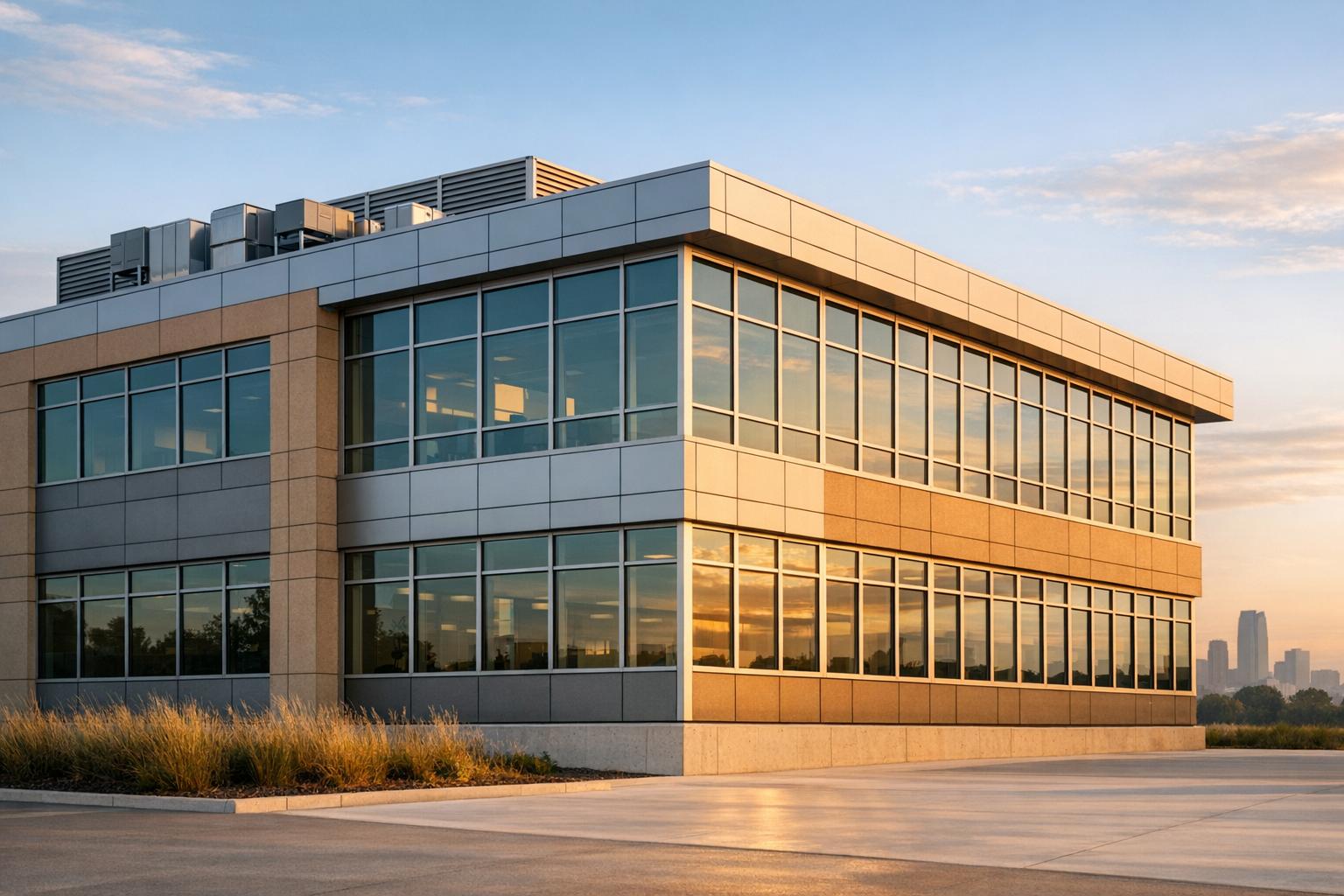
Oklahoma Energy Codes: Key Updates 2025
Oklahoma's 2025 energy code updates introduce stricter standards for commercial buildings, aligning with the 2021 IECC. These changes impact HVAC systems, insulation, windows, and air leakage requirements, aiming to improve energy efficiency and reduce long-term costs. Key updates include:
- HVAC Efficiency: Central air systems must meet a minimum of 15 SEER2, and gas furnaces require 80% AFUE.
- Building Envelope: Stricter insulation and U-factor standards for windows and doors, with mandatory air leakage limits.
- Compliance Options: Developers can choose between prescriptive and performance-based pathways, with new flexibility like a points-based system.
- Local Amendments: Cities like Oklahoma City and Tulsa may have additional requirements beyond state codes.
These updates increase initial costs but offer long-term savings, better tenant retention, and higher property values. Developers must ensure compliance with both state and local standards to avoid costly delays or redesigns.
An Energy Code Roadmap to Success in your Building Department
Key Changes to Building Envelope Requirements
The building envelope - made up of walls, roofs, windows, and floors - is responsible for most energy loss or gain in a building. The 2025 updates bring stricter rules for insulation, fenestration (windows and doors), and air leakage, aiming to improve overall energy efficiency.
Updated Insulation and R-Value Standards
Oklahoma's 2025 updates transition from the 2018 IECC to the 2021 IECC standards. While specific insulation values have been removed from prescriptive requirements, builders must still meet mandatory minimum insulation levels, regardless of a building’s energy score. This flexibility allows for design creativity while ensuring energy efficiency remains a priority.
"The IECC has mandatory minimum requirements such as insulation levels and window U-factors regardless of the ERI score. Posting a HERS score alone would not be sufficient to achieve code compliance." - OHFA Communications
This means even if a building achieves an impressive Energy Rating Index (ERI) or HERS score, it must still comply with the insulation standards set by the 2021 IECC. These changes are part of a broader effort to tighten regulations on all aspects of the building envelope.
Fenestration and U-Factor Adjustments
Stricter performance standards now apply to windows and doors. The updated 2025 rules treat U-factors as non-negotiable minimums, often referred to as "thermal envelope backstops". In other words, no amount of extra insulation or a high-performing HVAC system can compensate for windows that fail to meet the required U-factor.
References to Energy Star windows have been removed from some state codes because the 2021 IECC requirements align so closely with Energy Star's efficiency standards. Designers should directly verify U-factor compliance with the 2021 IECC instead of relying on an Energy Star label.
For prefabricated or partially prefabricated components, an extra compliance step has been introduced. Quality inspectors must now provide self-certification to confirm adherence to 2021 IECC fenestration standards during assembly. If you're using off-site construction, request the manufacturer’s materials list and installation photos to ensure compliance. These stricter window and door standards work hand-in-hand with the updated air leakage guidelines.
Tighter Air Leakage Guidelines
Air leakage is a significant source of energy loss, and the 2025 updates tackle it head-on. A continuous air barrier is now mandatory across the entire thermal envelope. This barrier can be placed inside, outside, or within the wall and roof assemblies, but all seams and joints must be sealed to withstand wind pressure, stack effect, and mechanical ventilation.
Here’s a breakdown of the updated air leakage metrics:
| Standard | Max Air Leakage Rate | Pressure Differential |
|---|---|---|
| 2021 IECC (Whole Building) | 0.40 cfm/ft² | 75 Pa (0.3 in. w.g.) |
| 2024 IECC (Whole Building) | 0.35 cfm/ft² | 75 Pa (0.3 in. w.g.) |
| Dwelling/Sleeping Units | 0.30 cfm/ft² | 50 Pa (0.2 in. w.g.) |
| Curtain Walls/Storefronts | 0.06 cfm/ft² | 75 Pa (1.57 psf) |
For buildings that skip whole-building testing, materials must have an air permeability no greater than 0.004 cfm/ft² under a pressure differential of 0.3 inch water gauge. Using "deemed to comply" materials, like ½-inch extruded polystyrene or 1.5-inch closed-cell spray foam, simplifies the verification process. If a building tests between 0.40 and 0.60 cfm/ft², it can still meet compliance if a diagnostic evaluation (e.g., using smoke tracers or infrared imaging) is conducted and all leaks are sealed.
Compliance Pathways for Commercial Properties
Oklahoma commercial property developers have two main options to meet the 2025 energy code standards: the prescriptive path and the performance-based path. The choice depends on the project's complexity and budget considerations.
Performance-Based Compliance
The performance-based path uses energy modeling to show that the building's energy use matches or surpasses that of a reference building. This option works well for complex projects, such as adaptive reuse, mixed-use developments, or buildings with unique architectural features. In these cases, meeting every individual component standard might not be feasible.
For example, a developer could use a high-performance glazing system but balance it with a more efficient HVAC system to achieve the required energy score. However, mandatory thermal envelope backstops must still be met.
"The HERS index allows for flexible assumptions to achieve the same score while the IECC has mandatory minimum requirements such as insulation levels and window U-factors regardless of the ERI score." - Oklahoma Housing Finance Agency
Performance-based submissions require detailed energy modeling documentation. Additionally, for buildings over 10,000 sq. ft., energy monitoring under Section C405.13 is mandatory - a reduction from the previous threshold of 25,000 sq. ft..
If this level of flexibility isn’t necessary, the prescriptive path offers a simpler alternative.
Prescriptive Compliance Pathway
The prescriptive path provides a straightforward approach: developers must meet specific minimum standards for each building component, such as insulation R-values and window U-factors. This method is ideal for standard commercial projects, such as retail spaces, conventional office buildings, or new construction with predictable designs, where verifying each component is manageable.
Documentation is easier with this path. Developers can submit a COMcheck report for officials to confirm compliance with required values. This eliminates the need for specialized energy modeling consultants, helping to keep costs more consistent.
Section C406 of the updated code adds flexibility by introducing a points-based system with over 50 options to earn additional efficiency credits. This feature is particularly useful for projects that need to adjust a single design element due to budget constraints while staying on the prescriptive track.
Finally, it’s important to check if your municipality in Oklahoma has adopted any local amendments. Cities like Oklahoma City, Tulsa, and Edmond operate under "home rule" authority and may have additional requirements beyond the state baseline.
How the 2025 Energy Codes Affect Commercial Real Estate
Cost Considerations for New Developments
The 2025 energy code updates bring new financial challenges for commercial developers in Oklahoma. One significant change stems from the U.S. Department of Energy's 2023 regional standards, which now require central air conditioning systems to meet a minimum of 15 SEER2 efficiency. This means developers must invest in higher-grade HVAC systems than before.
Additionally, duct leakage testing and system commissioning are now mandatory after construction. These steps not only add to the timeline but also increase costs. If a system fails these tests, it can delay permits and occupancy approvals, creating further complications.
Another potential hurdle lies in local amendments, particularly in home rule cities. Overlooking municipal requirements during the planning phase can lead to costly change orders once construction begins. The solution? Engage with local building departments and fire marshals early in the schematic design phase to avoid surprises.
"Failing to identify and apply these local requirements can lead to... Costly Change Orders: Discovering a local requirement during construction... can lead to expensive change orders." - Arpit Jain, MeltPlan
Although these updates increase initial expenses, they also pave the way for long-term financial advantages for property owners.
Long-Term Benefits for Property Owners
While upfront costs may rise, the long-term benefits for property owners make these changes worthwhile. Improved energy efficiency translates to lower operating expenses, better tenant retention, and higher property values.
The numbers speak for themselves. In 2024, over 8,800 commercial buildings achieved Energy Star certification, collectively saving $2 billion and preventing more than 5.7 million metric tons of emissions in just one year.
"More than 8,800 commercial buildings earned the Energy Star last year, saving more than $2 billion and preventing more than 5.7 million metric tons of emissions." - CNBC.com News
For Oklahoma property owners, aligning with the updated SEER2 and EER2 standards offers an added advantage: future-proofing. By meeting current federal appliance standards, buildings are less likely to require premature upgrades when future efficiency requirements roll out. This is especially valuable in a state like Oklahoma, where extreme seasonal temperatures across Climate Zones 3A and 4A demand reliable and efficient systems.
Oklahoma's C-PACE (Commercial Property Assessed Clean Energy) program further supports property owners by offering long-term, low-interest financing for energy efficiency projects. To date, nearly $100 million has been funded statewide, with over $42 million allocated to Oklahoma City for upgrades such as high-efficiency HVAC systems and improved building shells.
"C-PACE improves energy and water conservation and building performance by offering long-term, low-interest financing for private property owners without the burden of upfront capital." - Kenton Tsoodle, President, The Alliance for Economic Development of Oklahoma City
One standout example is the Alley North mixed-use development in Oklahoma City. In July 2025, this project utilized adjustable-rate C-PACE financing from Oklahoma County to fund energy-efficient improvements like advanced HVAC systems and enhanced building shells. The project earned recognition as "Innovative Deal of the Year" at the 2025 PACENation Summit for effectively combining public and private financing to meet modern energy standards.
2022 vs. 2025 Energy Code Standards: A Side-by-Side Look
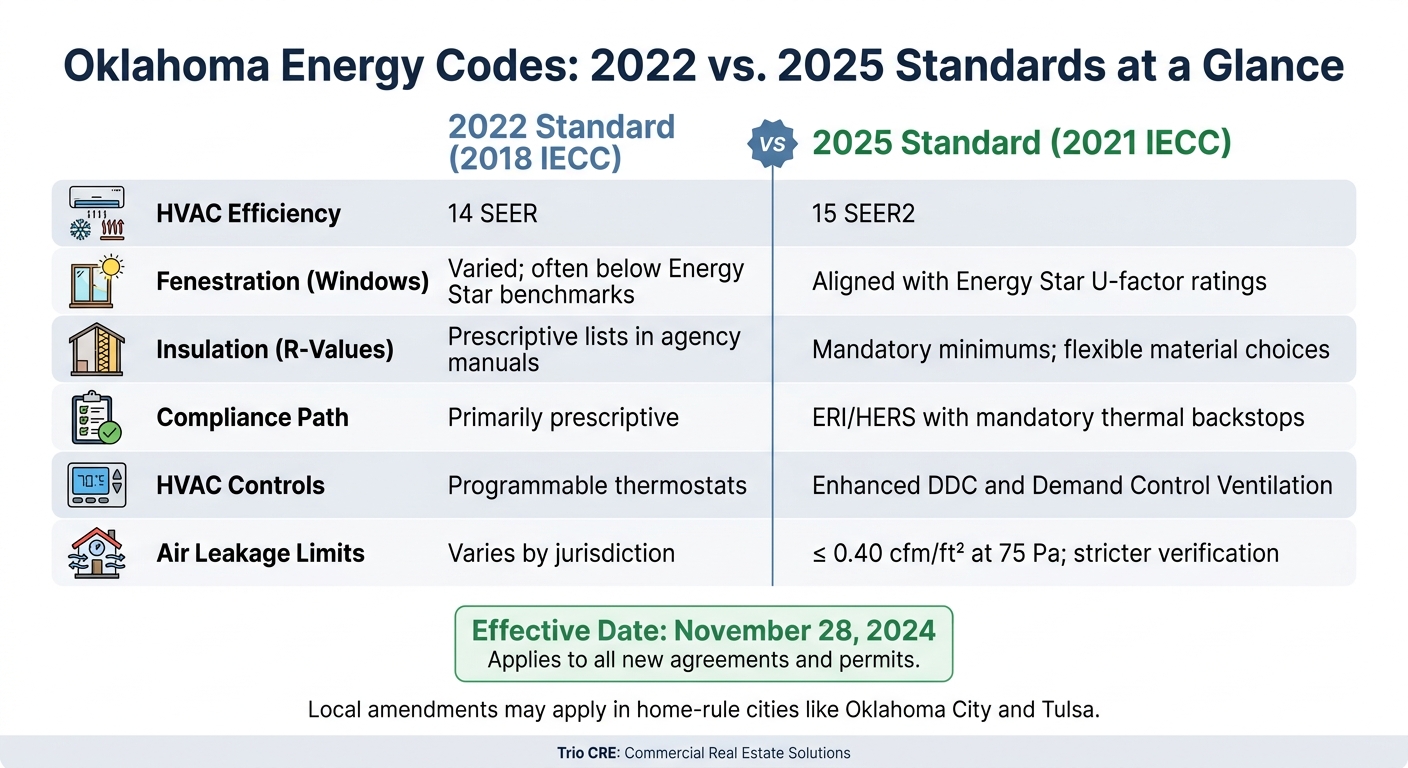
Oklahoma Energy Codes: 2022 vs 2025 Standards at a Glance
R-Value and U-Factor Comparison
One of the major updates between 2022 and 2025 standards is the shift from the 2018 IECC baseline to the 2021 IECC, which will apply to new agreements and permits starting November 28, 2024. This change introduces stricter minimum requirements for insulation and window performance.
Under the 2025 standards, insulation R-values and window U-factors are considered "thermal envelope backstops" - absolute minimums that must be met, no matter the results of a building's Energy Rating Index (ERI) or HERS assessment.
Window requirements have also been updated. The 2025 standards now align with Energy Star efficiency ratings for fenestration. This means that any window product meeting the required U-factor qualifies, without specifying a particular brand.
"The window requirements under the 2021 IECC closely matches the energy efficiency ratings of Energy Star windows, but the code does not specifically require the brand." - OHFA Communications
Here's a quick comparison of the key differences:
| Parameter | 2022 Standard (2018 IECC) | 2025 Standard (2021 IECC) |
|---|---|---|
| HVAC Efficiency | 14 SEER | 15 SEER2 |
| Fenestration (Windows) | Varied; often below Energy Star benchmarks | Aligned with Energy Star U-factor ratings |
| Insulation (R-Values) | Prescriptive lists in agency manuals | Mandatory minimums; flexible material choices |
| Compliance Path | Primarily prescriptive | ERI/HERS with mandatory thermal backstops |
| HVAC Controls | Programmable thermostats | Enhanced DDC and Demand Control Ventilation |
| Leakage Limits | Varies by jurisdiction | ≤ 4 CFM25 / 100 sq ft; stricter verification |
Changes in Sustainability Mandates
The 2025 standards go beyond just insulation and windows, extending their reach to overall building performance. These updates set firm benchmarks that developers must integrate during the design phase.
For commercial HVAC systems, there is now a requirement for Direct Digital Controls (DDC) and demand control ventilation, enabling real-time energy management based on occupancy and load conditions. Additionally, on-site renewable energy systems are now directly included in energy efficiency calculations, instead of being treated as optional extras.
The Oklahoma Housing Finance Agency (OHFA) has also removed prescriptive insulation lists from its manuals, allowing builders more flexibility in how they meet the minimum requirements.
However, this flexibility comes with added responsibility. Even with performance-based compliance options, the mandatory thermal envelope backstops remain in place. This means architects and mechanical, electrical, and plumbing (MEP) engineers need to collaborate early in the process to ensure that envelope design and mechanical system specs align, avoiding conflicts during the permitting stage.
Conclusion: Getting Ready for the 2025 Energy Codes
Key Takeaways for Property Owners, Developers, and Investors
The updated 2021 IECC standards bring a host of new requirements for commercial properties, setting a higher benchmark for energy efficiency. Among the changes are a minimum 15 SEER2 rating for cooling systems, stricter duct leakage limits, and mandatory demand control ventilation. These updates will significantly impact both new builds and major renovation projects.
In Oklahoma, developers often encounter an extra layer of complexity due to the state's "home rule" status. Cities like Oklahoma City and Tulsa have the authority to enforce local amendments that go beyond state-level codes. Ignoring these local mandates can lead to serious consequences, such as permit rejections, expensive redesigns, and approval delays. To avoid these setbacks, it’s essential to engage with local plan reviewers early in the process.
"Failing to identify and apply these local requirements can lead to significant problems: Permit Rejection... Costly Change Orders... Inspection Failures... Life Safety Risks." - MeltPlan
One of the smartest moves you can make is scheduling a pre-design meeting with local plan reviewers and fire marshals. Identifying jurisdiction-specific requirements during the schematic design phase is far less costly and time-consuming than addressing them after permits are filed.
How Trio CRE Can Help You Navigate Compliance

Meeting the 2025 energy codes is no small task, and the stakes are high. Compliance directly affects property values, lease agreements, and operational costs. Trio CRE specializes in integrating these code requirements into strategies for leasing, asset management, and acquisitions. For commercial property owners, developers, and investors in Oklahoma, understanding how these changes will impact your investments is critical. Whether you're planning a new project or assessing an existing property, Trio CRE offers the expertise to help you make informed decisions in today’s evolving market.
FAQs
When do Oklahoma’s 2025 energy code changes take effect for permits?
On September 14, 2022, Oklahoma implemented changes to its energy codes, which now align with the 2018 International Energy Conservation Code (IECC) with specific amendments. These updates bring adjustments to building envelope requirements and energy efficiency standards, impacting new permits moving forward.
Do performance-based designs still have to meet minimum insulation and window U-factors?
In Oklahoma, performance-based designs must meet specific energy efficiency standards, including minimum insulation and U-factor requirements. For instance, windows in Climate Zone 4 are required to have a U-factor of 0.32 or lower. These guidelines are part of the state's updated energy codes, aimed at improving energy efficiency across buildings.
What local amendments should I check in Oklahoma City or Tulsa before submitting plans?
When working on projects in Oklahoma City or Tulsa, it's crucial to review any local amendments to energy codes, especially those related to the building envelope, duct insulation, and Energy Rating Index (ERI) standards. These updates often address specific regional requirements that go beyond general codes.
Key areas to focus on include:
- Insulation R-values: Check if there are updated minimum R-value requirements for walls, roofs, or floors to ensure proper thermal performance.
- Air leakage limits: Confirm any stricter limits on air infiltration rates for both residential and commercial buildings.
- Duct insulation: Verify the required insulation levels for HVAC ductwork, which may vary based on location and system type.
- Compliance documentation: Ensure that all necessary forms and certifications meet the latest local standards for energy code compliance.
By staying informed about these details, you can avoid delays and ensure your plans align with Oklahoma City and Tulsa's specific energy code modifications.