Oklahoma CRE Supply Trends: Big Data Insights
Oklahoma's commercial real estate (CRE) market is shifting due to high office vacancies, fewer new constructions, and steady tenant demand. Here's what you need to know:
- Office Market: Oklahoma City reports a 25.9% office vacancy rate in Q1 2026, with demand focusing on higher-quality properties.
- Multifamily Housing: New unit deliveries dropped by 30% nationally, stabilizing vacancy rates and creating modest rent growth (about 2.9% projected for 2026).
- Industrial Growth: Oklahoma's industrial sector is expanding, driven by its central location, affordable energy, and tax incentives. Major projects include Google's $13.4 billion investment and aluminum smeltery developments.
- Construction Challenges: Rising costs, higher borrowing rates, and labor shortages are slowing new developments, pushing up project timelines and costs.
Big data is helping stakeholders make informed decisions by tracking trends like the "Supply Cliff", where national construction completions hit a 30-year low. This data-driven approach is critical for navigating Oklahoma's evolving CRE landscape.
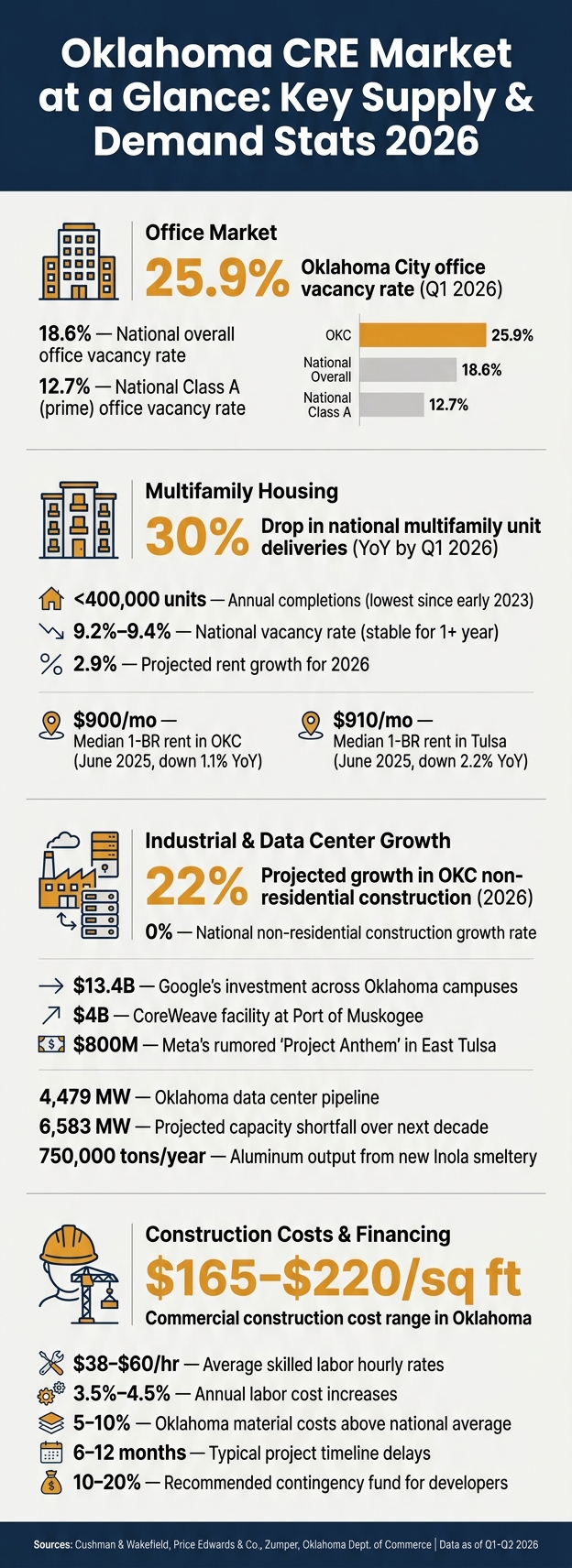
Oklahoma CRE Market at a Glance: Key Supply & Demand Stats 2026
EP150 2025 Central Oklahoma Real Estate Market Recap
Multifamily Supply Trends in Oklahoma
Oklahoma's multifamily market has been undergoing a shift. Following a period of heavy construction, the supply pipeline is now slowing, which is reshaping the market's dynamics.
Falling Unit Deliveries and Occupancy Rates
The multifamily sector is experiencing changes similar to those seen in office and retail spaces, thanks to the impact of big data. Nationally, multifamily unit deliveries dropped by about 30% year-over-year by Q1 2026, with annual completions dipping below 400,000 units for the first time since early 2023. This marks the lowest construction activity level since 2016, according to Cushman & Wakefield.
"Construction activity fell to its lowest level since 2016. Development continues to be constrained by higher financing costs, elevated construction expenses and more selective capital." - Sam Tenenbaum, Head of Multifamily Insights, Cushman & Wakefield
In Oklahoma City, the effects of the earlier construction boom are clear. Between 2023 and mid-2025, the North Oklahoma City submarket absorbed 6,848 new units across 34 properties. This influx caused occupancy rates to decline from 93%–94.7% to 92.8% by June 2025. At that time, Oklahoma City had 3,060 units under construction and 11,034 more in the planning stages. Meanwhile, Tulsa had 2,211 units under construction and 3,726 proposed units.
With fewer units being delivered, the market is showing signs of stabilizing. National vacancy rates have remained steady between 9.2% and 9.4% for over a year. Interestingly, Class A properties have seen a roughly 80-basis-point drop in vacancy rates as renters opt for higher-quality units, while Class B and C properties have experienced a similar increase in vacancies. These trends align with a broader commercial real estate narrative shaped by limited supply and changing tenant expectations, setting the stage for modest rent growth.
Rent Growth Projections Through 2026
Rent growth in Oklahoma has been relatively subdued. As of June 2025, the median rent for a one-bedroom unit in Oklahoma City was $900, reflecting a 1.1% year-over-year decline. In Tulsa, the median rent stood at $910, down 2.2%. Property owners are focusing more on maintaining occupancy rather than pushing for rent increases.
"The current plateau seen in our national rent prices likely reflects a more deliberate and strategic approach by property owners... landlords are prioritizing occupancy and staying competitive in an increasingly crowded landscape." - Anthemos Georgiades, CEO, Zumper
With fewer new units entering the market, vacancy pressures are easing, creating conditions for near-term rent growth of approximately 2.9%.
Industrial Supply Growth and Data Center Expansion
Oklahoma City's non-residential construction sector is projected to grow by 22% in 2026, compared to a flat 0% growth rate nationwide. This stark contrast underscores Oklahoma's unique position in the broader construction landscape.
Key Drivers Behind Industrial Growth
Oklahoma's industrial market is booming, thanks to three main factors: its central location, affordable energy, and attractive tax incentives. The state's central geography makes it a natural hub for distribution and manufacturing. Its low-cost energy is particularly appealing for power-intensive industries. On top of that, Oklahoma offers 25-year PILOT agreements, which provide 85–100% property tax abatements - an enticing deal for capital-heavy projects.
Google is pouring $13.4 billion into multiple campuses across Pryor, Stillwater, Sand Springs, and Muskogee. One standout project, "Project Spring", is taking shape on an 827-acre site along Highway 97 in Sand Springs as of March 2026. Other major players include CoreWeave, which is constructing a $4 billion facility at the Port of Muskogee, and Meta's rumored "Project Anthem", an $800 million venture in East Tulsa.
"Oklahoma is the center of the country, and that is a huge advantage from a distribution standpoint. We have the workforce and the site. We have good energy availability and economics." - John Budd, CEO, Oklahoma Department of Commerce
In addition, Emirates Global Aluminum and Century Aluminum Company have teamed up to develop the first new primary aluminum smeltery in the U.S. on a 437.5-acre site in Inola. This facility is set to produce 750,000 tons of aluminum annually, more than doubling the current U.S. output. It will also require a staggering 1.2 gigawatts of uninterrupted power over its 30-year lifespan.
These initiatives are not just boosting industrial production - they’re also altering the dynamics of local markets.
How New Industrial Developments Affect the Market
The surge in industrial activity is reshaping Oklahoma’s commercial real estate and employment landscape. For example, construction employment in the Oklahoma City metropolitan area increased by 7.1% year-over-year in 2025. The Inola smeltery alone is expected to create 1,000 permanent jobs and 4,000 construction jobs, signaling significant economic ripple effects. Secondary projects are also springing up, such as U.S. Aluminum Company’s reported plans to build a fabrication plant near the Inola smeltery.
However, this rapid development comes with challenges. Oklahoma's data center pipeline now totals 4,479 MW - enough energy to power roughly 3.7 million homes. Yet, utilities project a 6,583 MW capacity shortfall over the next decade. To address this, Governor Kevin Stitt signed SB 480 in May 2025, allowing data centers to generate their own power on-site. For developers and investors, reliable power access has become just as important as land costs when evaluating industrial sites in the region.
Supply Trends by Submarket
Oklahoma City's construction activity has scaled back dramatically, dropping from around 3,000 units under construction in mid-2024 to just 880 units by July 2025. This represents a mere 0.8% of the city's existing inventory. While the overall numbers paint a stark picture, the trends vary significantly across submarkets, each shaped by unique factors.
Northwest Oklahoma City: Steady Occupancy Amid Limited Supply
In Northwest Oklahoma City, a cautious approach to new construction has paid off. With a small pipeline, this submarket achieved a 90.1% occupancy rate as of Q2 2025, enabling annual rent growth to exceed 2% in areas with tighter supply. Stable demand and a lack of oversupply have allowed property owners here to enjoy consistent performance without major disruptions.
Canadian County: Balancing Population Growth and Supply Timing
Canadian County's story is more complex. A wave of new deliveries in 2025 temporarily slowed rent growth during the absorption phase, highlighting how even strong, population-driven demand can falter when too much supply enters the market at once. As these units are gradually absorbed and the construction pipeline shrinks, Canadian County is poised for a rebound. The population growth remains robust, ensuring demand isn’t the issue - the challenge lies in aligning supply with the pace of absorption.
Downtown Oklahoma City: Class A Supply Reshapes the Market
Downtown Oklahoma City faces its own set of challenges, driven by an influx of new Class A developments. Nationally, prime Class A buildings report a vacancy rate of 12.7%, compared to an overall office vacancy rate of 18.6% as of early 2026. Locally, this high-end supply is raising expectations among tenants, giving them more premium options and slowing the absorption of new units. For landlords of older properties, this shift creates pressure, as higher vacancy rates become harder to avoid.
Although new construction in Downtown is tapering off, the current wave of Class A properties will take time to be fully absorbed. Meanwhile, owners of older, less competitive buildings face a tougher road to recovery, as the market adjusts more from the supply side than from changes in demand.
Construction Costs and Financing Constraints
Oklahoma's construction industry is hitting a rough patch, with rising expenses and higher borrowing costs making it harder for developers to move forward with new projects. These challenges are squeezing profit margins and putting many developments on hold.
Rising Costs and Material Shortages
The cost of commercial construction in Oklahoma has climbed above $165 per square foot for most projects. For one-story office buildings, the price tag ranges from $160 to over $200 per square foot as of 2026. Other general commercial projects can go as high as $220 per square foot.
One major issue driving up costs is the tight labor market. Skilled workers like electricians, carpenters, and architects are in short supply, which gives workers the upper hand in negotiating wages. Hourly labor rates in Oklahoma average between $38 and $60, with annual increases of 3.5% to 4.5%. On top of that, material costs in the state are 5–10% higher than the national average, thanks to transportation fees and uncertainty around tariffs. These factors often push project timelines out by 6 to 12 months, making it crucial for developers to set aside a 10–20% contingency fund to handle unexpected expenses. These escalating costs are making it even harder to secure financing, creating a cycle that slows down new development.
Financing Barriers Slowing New Developments
High interest rates are adding another layer of difficulty, further discouraging developers from starting new projects. Oklahoma is feeling the pinch, with fewer projects breaking ground - a trend mirrored across the state’s various submarkets.
This slowdown in new construction has led to a more balanced market - not because demand is booming, but because the supply of new properties has nearly dried up. For property owners, this means less competition and potentially more leverage when negotiating leases. But for developers, the combination of steep construction costs and expensive borrowing is making new projects a hard sell through the rest of 2026.
Using Big Data to Navigate Oklahoma's CRE Market
The numbers tell an interesting story: Oklahoma's commercial real estate (CRE) market isn't collapsing; it's adapting. For instance, Oklahoma City's office vacancy rate stands at about 25.9% as of Q1 2026. Compare that to the significantly lower national vacancy rate of 12.7% for prime buildings, and you see a clear trend - demand is gravitating toward higher-quality properties, leaving older spaces behind. These shifts, backed by data, highlight opportunities for strategic decision-making.
One major trend to watch is the "Supply Cliff." Nationally, construction completions hit a historic low of just 1.3 million square feet in Q1 2026, the smallest quarterly total since 1990.
What does this mean for stakeholders?
- Tenants: Now is the time to lock in leases. With limited new construction, landlords could regain leverage as supply tightens.
- Investors: Consider targeting underperforming office buildings. There's growing momentum to convert these spaces into residential or industrial properties - an approach already gaining traction nationwide.
- Retail landlords: Focus on medtail tenants like urgent care centers, dental offices, and physical therapy providers. These businesses are increasingly moving into retail spaces and bring high-credit reliability, bolstering retail market stability across all analyzed regions.
Local insights are key. Price Edwards and Company provides building-specific data on Oklahoma City's CRE market through semi-annual and annual reports. Firms such as Trio CRE use this localized intelligence to stay ahead of supply and demand changes in Oklahoma's submarkets, proving that understanding local dynamics is just as important as tracking national trends.
FAQs
What is the 'Supply Cliff,' and why does it matter in Oklahoma?
The "Supply Cliff" refers to a possible steep drop in the availability of commercial real estate in Oklahoma. This is important because such a shift could lead to tighter market conditions, driving up rental costs and restricting new development opportunities. As Oklahoma experiences growth in areas like data center projects and other developments, keeping an eye on this trend is essential for predicting market changes and making informed plans.
Which Oklahoma City submarkets are most likely to see rent growth next?
Oklahoma City and Tulsa are likely to experience rising rents in 2024, with forecasts pointing to increases of about 2.4% in Oklahoma City and 3.3% in Tulsa. These changes stem from a combination of recovering demand and steady market conditions, signaling a positive trend for the rental market in both cities.
How big is the power risk for new data centers and industrial projects?
The energy challenge tied to new data centers and industrial projects in Oklahoma is hard to ignore. These facilities consume massive amounts of electricity, often surpassing what the current grid can handle. This strain not only pushes resources to their limits but also increases operational costs. Addressing this issue requires meticulous planning to balance energy demands efficiently.