Innovative Energy-Saving Technologies for Commercial Real Estate
Commercial buildings in the U.S. are responsible for 31% of greenhouse gas emissions and use 40% of the nation’s energy, with 25–30% of that energy wasted due to inefficiencies. Upgrading to energy-saving technologies can significantly reduce costs, improve property value, and lower emissions. Here’s how:
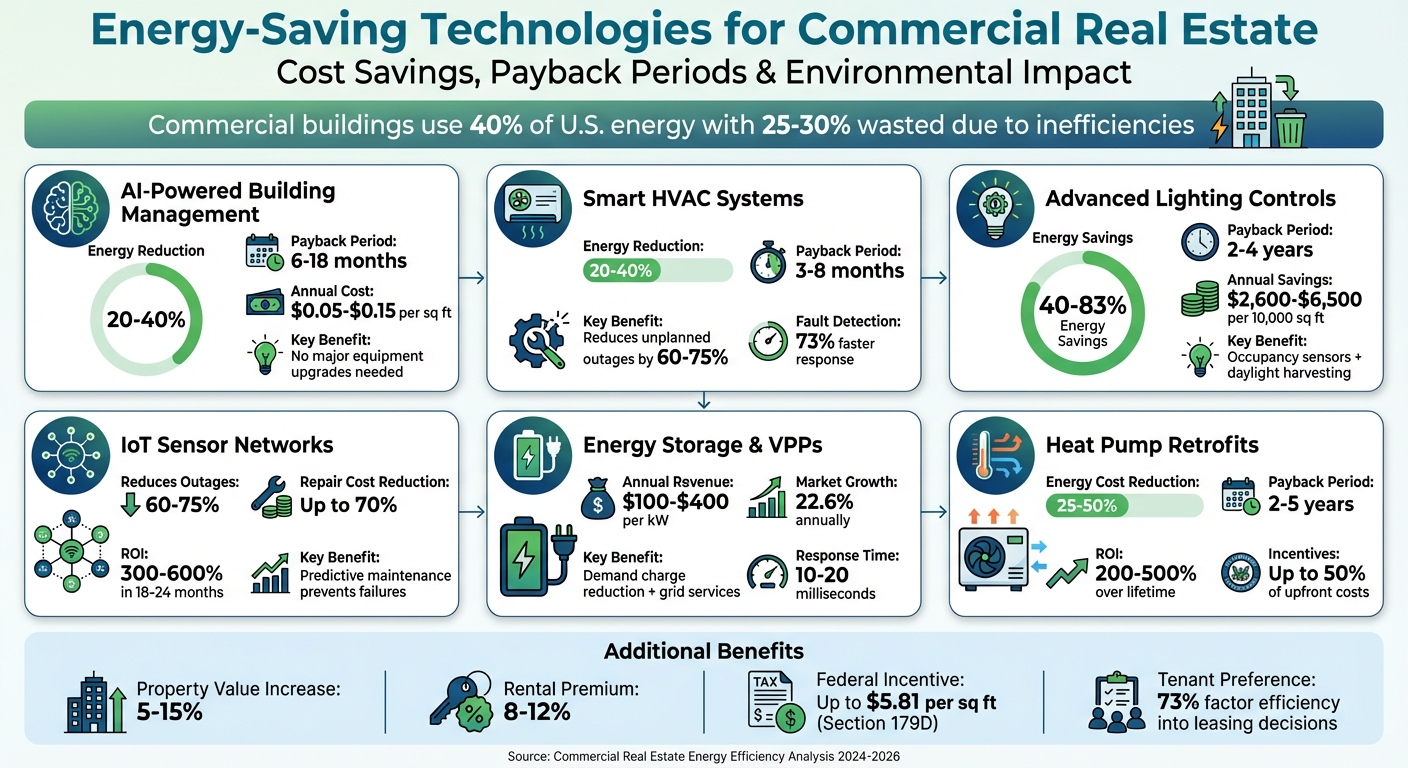
- AI-Powered Building Management: Cuts energy use by 20–40% without major equipment upgrades, with payback periods of 6–18 months.
- Smart HVAC Systems: Reduces energy waste by 20–40%, detects faults faster, and optimizes ventilation based on occupancy.
- Advanced Lighting Controls: Saves 40–83% in energy costs using occupancy sensors, daylight harvesting, and dimming technologies.
- IoT Sensor Networks: Enables predictive maintenance, reducing unplanned outages by 60–75% and cutting repair costs by up to 70%.
- Energy Storage: Provides cost savings through demand charge reduction, time-of-use arbitrage, and participation in energy markets.
- Heat Pump Retrofits: Reduces energy costs by 25–50%, with incentives covering up to 50% of upfront costs.
These solutions not only lower operating expenses but also help meet regulatory requirements and attract tenants seeking efficient properties. Federal incentives like Section 179D tax deductions can further offset costs, offering up to $5.81 per square foot for qualifying upgrades. Investing in these technologies is a smart move for property owners looking to cut waste, save money, and improve building performance.
Energy-Saving Technologies ROI and Savings for Commercial Real Estate
How to Improve Commercial Building Energy Efficiency - Without the Hype
AI-Powered Building Management Systems
Traditional building management systems often rely on rigid schedules, ignoring factors like occupancy, weather, or electricity pricing. AI-powered systems, however, adapt dynamically in real-time, making adjustments every 5–15 minutes based on current conditions.
With predictive control, these systems can pre-cool spaces using weather forecasts and occupancy data, avoiding energy waste caused by delays. For example, AI analyzes weather patterns, occupancy trends, and the building’s ability to retain heat or cool air to optimize pre-conditioning during off-peak hours when electricity costs less. Additionally, they can identify inefficiencies, such as perimeter zones requiring heat while interior zones need cooling - a mismatch that can waste 15–25% of HVAC energy in conventional systems.
How AI Improves Building Efficiency
AI platforms are designed to integrate seamlessly with existing systems using standard protocols, eliminating the need for expensive infrastructure upgrades. These platforms gather data from sensors, meters, and HVAC controllers to monitor factors like temperature, humidity, CO2 levels, occupancy (tracked via Wi-Fi or access cards), and equipment performance.
Machine learning models excel at spotting inefficiencies that human operators might overlook. For instance, if a floor is only 40% occupied, the system can lower airflow to that zone, reducing fan power consumption by up to 80%. AI also optimizes equipment start sequences to avoid simultaneous energy spikes and monitors for early signs of equipment failure. This approach can reduce demand charges by 15–30% and cut unexpected breakdowns by as much as 70%.
From a financial perspective, the case for AI is compelling. Software subscriptions typically cost $0.05 to $0.15 per square foot annually, with payback periods ranging from 6 to 18 months. For a 100,000-square-foot building, that translates to $5,000 to $15,000 per year in software costs, with potential energy savings of 20–40%.
Examples from the Field
In July 2016, Google leveraged DeepMind’s machine learning to optimize cooling in its data centers. By training neural networks on historical sensor data - such as temperature, power usage, and pump speeds - the AI predicted future Power Usage Effectiveness (PUE) and autonomously controlled the cooling systems. This led to a 40% reduction in energy used for cooling and a 15% decrease in overall PUE overhead.
Fast forward to October 2025, when 45 Broadway, a 32-story office building in New York City, implemented an AI HVAC optimization system managed by Rhino Energy with BrainBox AI. Over 11 months, the building achieved a 15.8% reduction in HVAC energy use, saving $42,000 in electricity costs and cutting 37 metric tons of CO2 emissions. The property manager called it:
"found money, and it helps the environment".
Dollar Tree took a broader approach, piloting BrainBox AI across several retail locations before scaling up. The initial deployment resulted in $1,028,159 in total cost savings, prompting the company to expand the technology to over 2,000 additional stores. Similarly, in Hangzhou, the Alibaba Xixi Campus Mall adopted an AI-driven energy management system in July 2025, achieving a 30% reduction in energy use during off-peak hours while maintaining occupant comfort.
These examples highlight how AI-driven tools are reshaping HVAC optimization, delivering impressive energy and cost savings while improving operational efficiency.
Smart HVAC Optimization Tools
HVAC systems play a massive role in energy consumption, often accounting for a significant portion of energy budgets. Shockingly, around 30% of HVAC energy is wasted on overcooling, overheating, or running in empty spaces. Smart HVAC systems, powered by dynamic AI strategies, are changing the game. These systems adapt to real-time conditions, cutting energy use by 20% to 40% within the first month of implementation. Even better, the investment often pays for itself in just 3 to 8 months.
Benefits of Smart HVAC Systems
Smart HVAC tools bring energy savings through a mix of advanced techniques. For instance:
- Outcome monitoring: IoT sensors ensure cooling is efficient, not just operational.
- Predictive load management: By analyzing weather forecasts and historical data, buildings can be pre-conditioned for optimal energy use.
- Dynamic setpoint optimization: Supply air and chilled water temperatures are adjusted in real time based on actual zone needs, avoiding inefficient worst-case assumptions.
These systems also excel in fault detection, identifying issues like refrigerant leaks, fouled coils, or stuck dampers within 24–72 hours - far faster than the months it can take with manual inspections.
Another standout feature is demand-controlled ventilation, which uses CO₂ sensors to regulate fresh air intake based on actual occupancy. This significantly reduces the energy required to process outside air.
However, for these tools to reach their full potential, integration with the Building Management System (BMS) is crucial. A case study highlights this point:
"The problem was not the BMS itself - it was that the maintenance team operated in a completely separate system... There was no formal link between what the BMS detected and what the maintenance team actioned." - Oxmaint Case Study
When BMS and maintenance workflows are properly connected, facilities can respond to equipment faults 73% faster.
Case Study: Siemens Desigo CC
Siemens Desigo CC offers a holistic approach to building optimization, combining HVAC, lighting, and power systems into one platform. By factoring in schedules, occupancy levels, and weather forecasts, the system optimizes resource use across the board. Siemens describes its functionality:
"Desigo CC balances energy consumption while maintaining occupant comfort by integrating meters and circuit breakers to optimally schedule consumers, generators and batteries." - Siemens
The impact of this system is evident in real-world applications. Take, for example, a 40-story, 620,000 sq ft mixed-use office tower that implemented Siemens Desigo CC in March 2026. Before the upgrade, the building faced an annual energy bill of $4.3 million, with HVAC accounting for 61% of the total. By integrating Desigo CC with iFactory's CMMS platform, the facility achieved:
- A 28% reduction in HVAC energy use
- $1.2 million in annual energy savings
- A 35-point boost in tenant comfort scores
- A 14% drop in chiller plant demand
- A reduction in average fault detection-to-resolution time from 26.7 hours to just 4.1 hours.
For commercial properties ranging from 200,000 to 800,000 sq ft, similar BMS-CMMS integration projects typically pay off in 8 to 15 months. This case underscores how smart HVAC tools, paired with effective maintenance strategies, can deliver impressive results.
Advanced Lighting Control Systems
After delving into HVAC and AI systems, it's clear that lighting controls present another key opportunity to improve energy efficiency. Lighting accounts for about 40% of energy usage, making it a prime candidate for cost savings. Advanced lighting control systems ensure that lights are used only when necessary. These systems rely on technologies like occupancy sensors, daylight harvesting, dimming controls, and automated scheduling, all working together to reduce waste.
Energy Savings Through Smart Lighting
The numbers speak for themselves: combining LED fixtures with intelligent controls can cut energy use by 40% to 83% compared to traditional lighting setups. Each type of control contributes to these savings in unique ways:
- Occupancy sensors: Reduce energy usage by 20% to 40%.
- Daylight harvesting: Cuts consumption by 15% to 30%.
- Dimming controls: Add another 10% to 30% in savings.
- Automated scheduling: Contributes reductions of 15% to 25%.
"Lighting controls transform energy waste into measurable savings by ensuring lights operate only when and where needed, delivering reductions that LED fixtures alone cannot achieve." - LED Supply & Fit
A 10,000-square-foot office, for example, could save $2,600 to $6,500 annually, with a payback period of just two to four years. Beyond these immediate financial benefits, advanced lighting systems can also enhance a building's Energy Performance Certificate (EPC) rating. This not only increases property value but also makes spaces more appealing to tenants. When integrated into a broader IoT sensor network, smart lighting becomes a vital part of comprehensive energy management.
Integration with IoT Sensors
IoT-enabled lighting systems take efficiency to the next level by connecting sensors and fixtures through digital protocols like DALI, Bluetooth Mesh, and ZigBee. These advanced setups allow for precise control of individual fixtures. Sensors such as PIR, ultrasonic, and photocells automatically adjust lighting based on occupancy and natural light levels.
Take daylight harvesting, for example. These systems dim or turn off electric lights when natural light is sufficient, ensuring consistent illumination while cutting power usage. In open-plan offices, automated systems equipped with occupancy sensors and personal controls can reduce energy consumption by about 32%. To avoid flickering during sudden weather changes, advanced controls use "dead-band" logic to maintain stable light levels.
Connecting these lighting systems to a Building Management System (BMS) ensures they work in harmony with HVAC and other building functions. This eliminates waste, like lights being left on in empty rooms, and supports a more unified approach to energy management.
For commercial property owners, working with experienced providers like Trio CRE can help ensure seamless integration of these advanced lighting solutions, maximizing both energy savings and property value.
IoT Sensor Networks for Real-Time Monitoring
Building on the concept of lighting controls, IoT sensor networks take monitoring to a whole new level. These systems act as a continuous stream of data, collecting insights from thousands of points across HVAC, electrical, and plumbing systems. This shift allows property managers to move from reactive maintenance to predictive operations, identifying potential issues weeks before they escalate into costly problems.
Using wireless gateways like LoRaWAN, Bluetooth Low Energy (BLE), or Wi-Fi, sensor data is transmitted to centralized platforms such as building management systems (BMS) or energy management systems (EMS). By consolidating data from various equipment - like boilers, chillers, and meters - into a single platform, these networks eliminate data silos and enable comprehensive analysis. The result? Performance optimization that can reduce energy consumption by 15% to 25%.
"IoT sensors in commercial buildings represent the frontline defense against equipment failures, with intelligent monitoring systems tracking 1,000+ data points per minute... transforming reactive maintenance into predictive operations." - OxMaint
The benefits are substantial: IoT-enabled predictive maintenance can cut unplanned outages by 60% to 75% and deliver a return on investment (ROI) of 300% to 600% within 18 to 24 months. Consider this: a single day of HVAC failure in a 200,000-square-foot office building could cost between $15,000 and $40,000 in lost productivity and emergency repairs. Real-time monitoring helps avoid these scenarios by sending immediate alerts for issues like water leaks, overheating, or excessive humidity, allowing for quick fixes either remotely or on-site.
Key Applications of IoT in Energy Management
IoT sensors monitor multiple systems at once, each playing a role in optimizing energy use. For example:
- Temperature and humidity sensors help HVAC systems maintain precise indoor climates, avoiding wasted energy from over-cooling or overheating.
- Occupancy and motion sensors using technologies like passive infrared (PIR) and ultrasonic detection ensure lighting, HVAC, and plumbing operate only when spaces are in use. This is crucial, as 30% to 50% of energy in commercial buildings is currently wasted.
Other sensors add even more layers of insight:
- Vibration sensors on motors and pumps detect wear or imbalance two to six weeks before failure.
- Power monitoring sensors track lighting circuits to identify overloads or phase imbalances one to four weeks in advance.
- Water leak sensors send alerts within 30 to 60 seconds of detecting leaks or clogs, particularly in vulnerable areas like restrooms and mechanical rooms.
With HVAC systems accounting for 39% of commercial energy use in the U.S., these tools are indispensable. For maximum impact, property managers should prioritize high-risk assets like chillers and boilers, which offer the highest ROI through avoided emergency repairs. For instance, while emergency chiller repairs can cost between $35,000 and $85,000, planned repairs using IoT monitoring are 60% to 70% cheaper.
Scalability in Commercial Real Estate
One of the standout features of IoT sensor networks is their scalability. These systems are designed for wireless retrofitting, making it easy to integrate sensors into existing infrastructure without expensive construction or wiring. This flexibility works for single office buildings, multi-tenant complexes, and even mixed-use developments. With a "one-to-many" architecture, multiple sensors can connect to a single hub or gateway, simplifying large-scale management.
"Integration of IoT in buildings plays a crucial role in evolving methods of supervision and management of properties. It gradually transforms traditional buildings into intelligent structures capable of dynamically and efficiently meeting user needs and environmental challenges." - Wattsense
For larger portfolios, the LoRaWAN protocol stands out for its ability to cover long distances and penetrate building structures without complicated wiring. Deployments can start small - focusing on two or three critical systems - and then expand to secondary equipment and eventually the entire property portfolio. This phased approach enhances predictive maintenance across a wide range of assets. Buildings using integrated platforms can achieve 99.5%+ system availability and reduce repair times by 70%.
To make the most of these networks, it’s wise to choose solutions based on open standards rather than proprietary technologies, ensuring future flexibility and avoiding "technological silos". Implementing tiered alert systems - emergency alerts for critical issues and scheduled ones for gradual concerns - can prevent alert fatigue. Start with conservative thresholds and refine them over 60 to 90 days to maintain false positive rates below 5%.
Collaborating with experienced advisors like Trio CRE can help property owners develop IoT strategies tailored to long-term goals. This ensures these networks deliver maximum energy efficiency and improve overall property performance.
Energy Storage and Demand Response Solutions
Energy storage technologies are reshaping how commercial buildings interact with the grid. By pairing data-driven insights with advanced storage solutions, these systems go beyond efficiency - they offer direct cost savings and even revenue opportunities. Commercial properties are no longer just energy consumers. With tools like battery storage and demand response, they can actively participate in electricity markets, reducing costs and emissions while earning money.
Virtual Power Plants and Battery Storage
Virtual Power Plants (VPPs) bring together distributed energy resources - like batteries, HVAC systems, and solar inverters - into a single, coordinated power source. By 2025, VPPs managed 37.5 gigawatts of capacity across the U.S., with the market valued at $6.3 billion in early 2026 and growing at an impressive 22.6% annually.
In February 2026, Lunar Energy secured $232 million to expand its AI-driven "Gridshare" platform, which now oversees 650 MW of assets across states like California, New England, Hawaii, and Puerto Rico. Around the same time, SOLRITE Energy launched Texas's first battery-only VPP program in the ERCOT market, using sonnen storage systems. This initiative opened the door for customers without rooftop solar to participate, proving that on-site generation isn't a requirement.
"VPPs aren't just another energy technology - they're fundamentally rewriting the economics of grid infrastructure, creating entirely new markets, and turning passive electricity consumers into active grid participants who get paid for flexibility." - Brett Vogeler, Business Broker, 360 Perspective Partners
Battery storage systems also play a critical role in addressing utility interconnection delays. For example, Aligned Data Centres in Hillsboro, Oregon, installed a 31 MW / 62 MWh battery system in early 2026. This allowed the facility to handle partial load service years ahead of full grid upgrades, demonstrating how storage can accelerate time-to-market for large-scale projects.
Cost Savings and Grid Benefits
Energy storage offers a wide range of financial benefits. Beyond serving as backup power, these systems allow commercial properties to tap into multiple revenue streams, including:
- Time-of-use arbitrage: Charge batteries during low-cost off-peak hours and discharge during expensive peak periods.
- Demand charge reduction: Lower peak demand costs on utility bills.
- Capacity payments: Earn for being available to the grid.
- Ancillary services: Provide grid support, such as frequency regulation.
Participation in wholesale energy markets can yield $100–$300 per kilowatt annually, while frequency regulation services in regions like PJM or CAISO pay between $200–$400 per kilowatt.
The real-world impact of these systems is evident. During a January 2024 polar vortex, Green Mountain Power's VPP of over 3,000 home batteries saved $500,000 in one event, with annual savings exceeding $2 million. Similarly, Tesla's Virtual Power Plant enrolled over 50,000 Powerwall batteries across Texas and California. In August 2024, during severe heat waves, this fleet delivered 500 megawatts of capacity within minutes, preventing blackouts and earning participating customers between $400 and $1,000 annually.
Operationally, battery systems provide rapid backup power - responding in just 10–20 milliseconds - to ensure critical systems stay online during outages. Advanced analytics further optimize performance, increasing usable battery capacity by 5–15% during extreme weather. For property owners, analyzing 12 months of 15-minute load data can help estimate returns on strategies like peak shaving and arbitrage. Partnering with experienced advisors, such as Trio CRE, can simplify the evaluation process and align these technologies with long-term goals.
Heat Pump Retrofitting Technologies
Heat pump retrofits are reshaping how commercial buildings manage heating and cooling. Instead of generating heat, heat pumps transfer it, achieving up to three times the efficiency of oil-based systems. For commercial properties with outdated HVAC setups, this technology offers a practical way to cut costs and improve performance.
Advantages of Heat Pumps in Retrofits
The financial benefits of heat pump retrofits are clear. Energy costs can drop by 25–50%, and modern rooftop units can slash energy use by as much as 50% compared to traditional systems. These savings quickly accumulate - most retrofits pay for themselves within 2 to 5 years and deliver a return on investment (ROI) ranging from 200% to 500% over the equipment's lifespan.
Another major advantage is the reduced need for frequent and costly repairs. As Gary Musaraj, Owner of Jupitair HVAC, explains:
"The monthly repair bills plus wasted energy on those old systems actually cost more than the financing payments on new equipment would".
Buildings with HVAC systems that are 15–20 years old or running below 70% capacity are prime candidates for retrofits.
Heat pump technology has also made huge strides in cold-weather performance. In early 2024, Carrier Global Corporation conducted field trials for its 10–14-ton modern rooftop heat pump at a national retailer in upstate New York. The system delivered 100% heating capacity at 5°F and over 70% capacity at -10°F. Heidi Gehring, Managing Director of Light Commercial at Carrier, commented:
"These field trials are the final step before launching a high-performance product designed to strengthen U.S. commercial buildings".
Cost Savings and Incentives
Upfront costs for retrofits can be significantly reduced through various incentives. Utility rebate programs, like Oncor's, offer $500–$2,000 per ton for high-efficiency equipment. Federal tax credits can cover 10–30% of project expenses. Together, these incentives can offset 40–50% of the total cost. Additionally, integrating heat recovery systems with heat pumps can lower ventilation energy costs by 40–60%. To maximize savings and incentives, working with specialists such as Trio CRE can help identify the most cost-effective upgrades.
Boosting Property Value
The benefits of retrofitting go beyond energy savings. Buildings with modern HVAC systems often command 10–15% higher rents and see their appraised values rise by 5–15%. For retrofit projects costing anywhere from $10,000 to over $500,000, these value increases make heat pump upgrades a smart investment for long-term property performance. By reducing operational costs and enhancing property appeal, heat pump retrofits align perfectly with broader energy-saving strategies.
Conclusion
The energy-saving solutions we've explored here are pivotal for staying competitive and maintaining profitability in today's market. By tackling inefficiencies in commercial buildings head-on, these technologies cut down on wasted energy through the use of predictive intelligence and real-time monitoring.
The financial benefits are hard to overlook. For instance, AI-driven HVAC optimization and LED retrofits often pay for themselves within 6–18 months and 1–2 years, respectively. On top of that, energy-efficient buildings can command rental premiums of 8–12% compared to traditional properties. These numbers underscore the importance of integrated systems that monitor and automate energy use across a building's operations. With 73% of commercial tenants now factoring energy efficiency into their leasing decisions, it's clear that this has become a key competitive edge.
Regulatory pressures are also mounting. Cities like New York are enforcing steep fines for emissions violations, making compliance a growing concern. Predictive systems offer a way forward by adapting to hybrid work patterns, cutting energy use in unoccupied areas, and optimizing performance - all without the need for costly hardware overhauls.
A smart starting point? Conducting a comprehensive energy audit. This helps pinpoint which systems are the biggest energy drains and identifies where upgrades will yield the best returns. Plus, taking advantage of incentives - like utility rebates or federal tax benefits under Section 179D - can slash implementation costs by 30–50%. Working with experts like Trio CRE ensures you can tailor these upgrades to your property, selecting the right technologies and incentive programs for maximum impact.
Waiting to act could cost you dearly - up to 20–35% of your HVAC budget every single month. The real question is: how quickly can you take these steps to secure savings and efficiency?
FAQs
Which upgrade should I do first in my building?
One upgrade worth considering is an advanced Building Management System (BMS). These modern systems bring together HVAC, lighting, security, and energy management into a single, integrated solution. With real-time data, fault detection, and automation capabilities, a BMS helps streamline operations.
By optimizing the performance of your building’s systems, this upgrade can lead to noticeable reductions in energy usage and operational expenses. It's a smart way to enhance efficiency while keeping costs in check.
How do I estimate payback before installing these technologies?
To figure out the payback period, simply divide the total cost of the investment by the annual savings the technology provides. For instance, if a retrofit costs $100,000 and saves $50,000 per year, the payback period would be 2 years. In commercial properties, many energy retrofits target a 20% return rate to make the investment worthwhile. This method helps assess whether the savings offset the upfront costs and determines how long it will take to recoup the investment.
What incentives can lower the upfront cost of energy upgrades?
Incentives, such as the energy-efficient commercial buildings deduction under IRC Section 179D, can help reduce upfront costs for building projects. This tax deduction starts at $0.50 per square foot for achieving 25% energy savings. For every additional percentage point of energy savings above 25%, the deduction increases by $0.02 per square foot, with a maximum possible deduction of $1.00 per square foot.