How LEED Certification Impacts Property Value
LEED certification significantly boosts property value and rent potential while lowering operating costs. Certified buildings command 31% higher rents on average compared to non-certified ones and enjoy a 4% property value increase. They also use up to 39% less energy, reducing utility expenses and increasing net income. In Oklahoma, LEED-certified properties benefit from state incentives like tax credits and expedited permitting, making them more appealing to tenants and investors. With rising tenant demand for energy-efficient, healthier spaces, non-certified buildings face challenges like lower rents and higher vacancy rates. For property owners, pursuing LEED certification is a smart move to stay competitive in today’s market.
What is a LEED Certified Building
Key Challenges in Oklahoma's Commercial Real Estate Market
Oklahoma's commercial real estate market is navigating a tricky landscape. The rise of hybrid work has fundamentally altered how businesses use office space, leaving many property owners with buildings that no longer align with tenant needs. This shift has widened the gap between properties that thrive and those that struggle, creating a market increasingly defined by performance disparities. At the core of these challenges are rising costs and shifting tenant expectations.
Higher Costs for Non-Certified Buildings
Operating expenses for non-certified buildings are a major hurdle. These properties use 14% more energy per square foot compared to LEED-certified buildings, leading to steeper utility bills and higher maintenance costs. This inefficiency cuts into net income and makes it harder to compete for tenants.
CBRE Research highlights this disparity with what’s known as the "brown discount":
"The premium only exists when comparing LEED to non-LEED; hence, some have used the 'brown discount' to describe the rent discount of non-certified buildings."
But the financial strain doesn't stop at lower rents. Owners of non-certified buildings also face greater risks of mortgage defaults, adding another layer of financial vulnerability beyond leasing concerns.
What Tenants Now Expect from Commercial Properties
Tenant expectations have shifted dramatically in the post-pandemic world. Features like indoor air quality, wellness amenities, and energy efficiency are no longer optional - they’re essential. Additionally, many tenants are prioritizing corporate sustainability goals, actively seeking properties with certifications like LEED or Energy Star®.
This trend, often called a "flight to quality", is driving demand for newer or sustainability-focused buildings. For example, office spaces built after 2012 command a 14% rent premium compared to those constructed between 2002 and 2011. This creates a tough competitive environment for older, non-certified properties, especially in suburban areas where only 40% of rentable square footage is LEED-certified. For these properties, the lack of certification represents a significant disadvantage, leaving them more vulnerable to the "brown discount."
LEED certification has become a key factor in addressing these challenges, helping properties meet modern tenant demands while boosting their market appeal and operational efficiency.
How LEED Certification Addresses These Challenges
LEED certification helps property owners in Oklahoma tackle today’s market demands by lowering operating costs, attracting high-quality tenants, and increasing property value.
The Four LEED Certification Levels Explained
LEED operates on a points-based system, where projects earn points for factors like energy efficiency, water conservation, air quality, and sustainable materials. The total points determine the certification level:
| Certification Level | Points Required |
|---|---|
| Certified | 40–49 points |
| Silver | 50–59 points |
| Gold | 60–79 points |
| Platinum | 80+ points |
Here’s an interesting insight for Oklahoma property owners: national data shows there’s no significant rent difference between Gold and Silver certification. The real financial leap comes from achieving any certification at all. Even the entry-level LEED Certified status can give your property a competitive edge over non-certified buildings.
Grasping these levels is the first step to understanding their financial impact.
Measurable Financial Benefits of LEED Certification
The financial advantages of LEED certification are clear. On average, LEED-certified office buildings command rents that are 31% higher than their non-certified counterparts. Even when factors like location, building age, and renovations are considered, a ~4% rent premium still holds steady. Additionally, LEED certification is tied to a 4% increase in overall property value.
For Class B properties, the benefits are even more pronounced. LEED-certified Class B buildings see a 4% rent premium, which is double the 2% premium observed in Class A buildings. This is particularly relevant in Oklahoma’s suburban areas, where Class B properties dominate and certification can help them stand out.
"There is a big competitive advantage for owners to secure LEED certification as tenants and city governments become more green-conscious." - CBRE Research
Energy savings add another layer of appeal. LEED-certified buildings, on average, use 10% less energy on-site compared to conventional buildings. This translates to lower operating costs, a major draw for tenants with triple-net leases.
Oklahoma-Specific Incentives for LEED-Certified Properties
Beyond higher rents and property values, Oklahoma also offers additional incentives that strengthen the financial case for LEED certification. State and local governments often provide perks like tax credits, zoning allowances, reduced permit fees, and expedited permitting. These benefits can significantly offset the upfront costs of certification, which typically add about 2% to construction costs, or roughly $3–$5 per square foot in soft costs.
For property owners in Oklahoma, these incentives shorten the payback period and improve the overall return on investment.
The Numbers Behind LEED Certification's Financial Impact
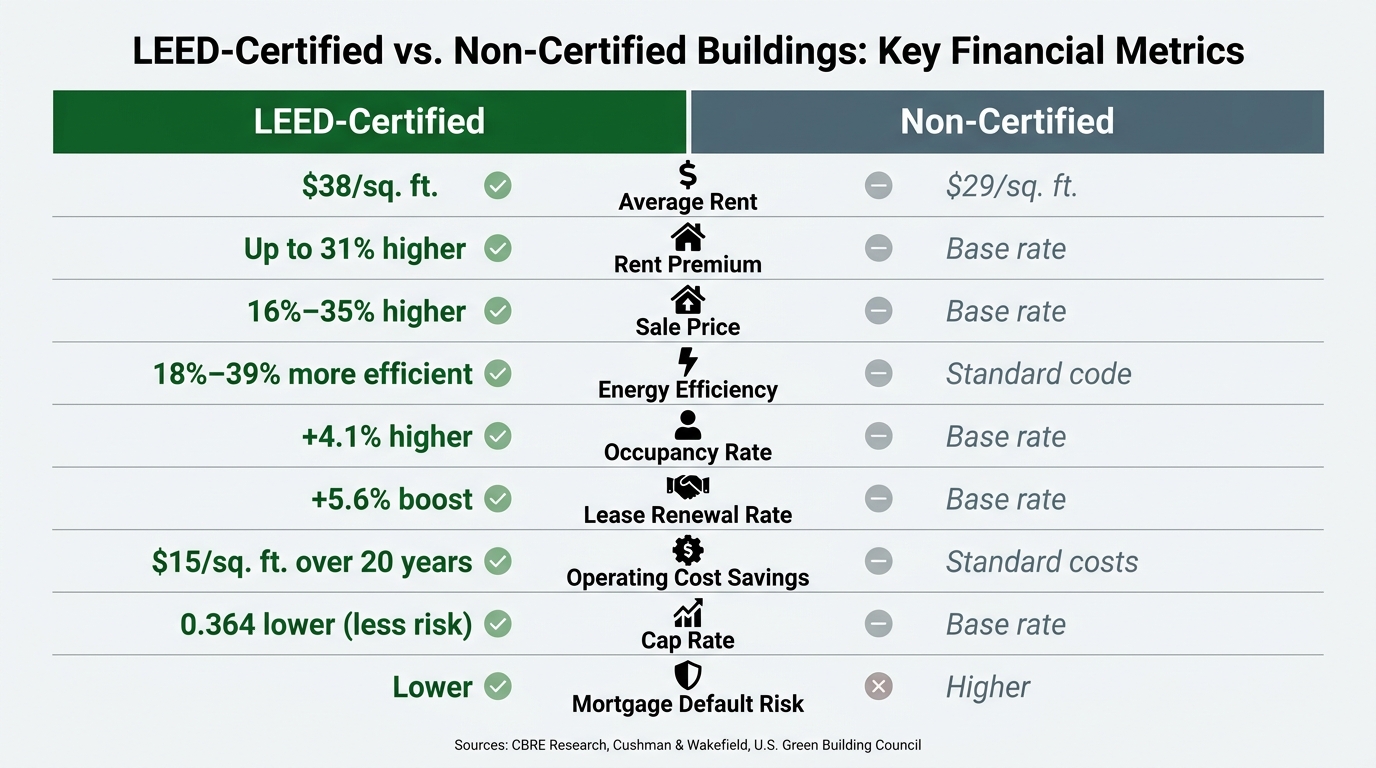
LEED-Certified vs. Non-Certified Buildings: Key Financial Metrics
LEED certification doesn't just bring environmental benefits - it also delivers serious financial perks. From increased rent premiums to energy savings, the numbers highlight why green buildings are a smart investment. Let’s break down these financial advantages.
Rent Premiums and Sale Price Increases
LEED-certified properties consistently outperform their non-certified counterparts when it comes to rents and sale prices. Green buildings sell for 16%–35% more than conventional properties. The impact is even more pronounced for specific building types. For instance, Class A suburban office buildings with LEED certification enjoy a 40.9% price-per-square-foot premium, according to Cushman & Wakefield.
"LEED-certified Class A suburban office achieved a 40.9% premium over non-certified assets." - Cushman & Wakefield
On the rental side, each step up in certification levels (e.g., from Certified to Silver) adds about a 3% rent premium. These incremental gains make pursuing higher certification levels a financially sound decision.
Energy Savings and Lower Operating Costs
LEED certification isn't just about higher property values and rents - it also delivers major savings in operating costs. LEED buildings use 18% to 39% less energy per square foot compared to standard buildings. Over time, these savings add up. For example, a LEED-certified property can save $15 per square foot in operating costs over 20 years.
But the benefits don’t stop there. Improved indoor air quality and thermal comfort in LEED buildings can boost productivity, translating into an additional $35–$55 per square foot in value over two decades.
The ripple effect on property value is impressive. According to the American Institute of Architects:
"Every dollar saved in energy costs can increase a building's market value by $18.32 assuming a capitalization rate of 5.5%." - AIA
For example, saving $50,000 annually in energy costs could increase a building's market value by over $900,000 - a return that far outweighs the initial investment in certification.
LEED vs. Non-LEED Properties: Side-by-Side Comparison
Here’s a quick look at how LEED-certified properties stack up against non-certified ones:
| Metric | LEED-Certified | Non-Certified |
|---|---|---|
| Average Rent | $38/sq. ft. | $29/sq. ft. |
| Sale Price Premium | 16%–35% higher | Base rate |
| Occupancy Rate | 4.1% higher | Base rate |
| Energy Efficiency | 18%–39% more efficient | Standard code |
| Operating Cost Savings | $15/sq. ft. over 20 years | Standard costs |
| Cap Rate | 0.364 lower | Base rate |
One standout metric is the lower capitalization rate for LEED properties. A reduced cap rate signals lower perceived risk, which translates to higher valuations and more favorable financing options for investors. When you combine these factors, it’s clear that LEED certification offers a compelling financial edge.
How LEED Certification Attracts Better Tenants and Investors
LEED certification doesn't just boost a property's stats - it makes it far more appealing to tenants and investors alike.
Growing Tenant Demand for Green Office Space
Today’s commercial tenants, especially large corporations, are looking beyond just square footage. Many have sustainability goals or Environmental, Social, and Governance (ESG) mandates that push them to operate in certified green buildings. LEED certification provides exactly what they need - a trusted, third-party-verified label that aligns with their values.
"Making buildings more sustainable is a wise investment (it pays). Secondly, tenants care about certification (the badge matters)." - James Gray-Donald, Vice President of Sustainability, Bentall Kennedy
LEED-certified spaces don’t just attract tenants - they keep them. These properties enjoy 4% higher occupancy rates and a 5.6% boost in lease renewals. In places like Oklahoma's suburban markets, where green office spaces are still scarce, certified buildings hold a clear edge.
There's also a shift to suburban office parks as companies aim to reduce commute times for employees. This trend is driving up demand for certified green spaces outside urban cores, creating a prime opportunity for property owners in Oklahoma.
As tenants increasingly prioritize sustainability, investors are taking notice too, viewing LEED certification as a smart move for long-term stability.
Why Investors Favor LEED-Certified Properties
For investors, LEED-certified buildings represent more than just tenant appeal - they’re a safeguard against market risks and a driver of long-term value. Properties with green certifications show lower mortgage default risks compared to traditional buildings. They're also less likely to face the "brown discount", where non-certified properties lose value as market expectations shift toward sustainability.
Even when factors like building age, location, and renovation history are accounted for, LEED-certified properties consistently command higher rents. For Class B properties, the benefits are even greater. LEED-certified Class B buildings earn a 4% rent premium, compared to 2% for Class A buildings. This is largely because certified Class B spaces are much harder to find.
"There is a big competitive advantage for owners to secure LEED certification as tenants and city governments become more green-conscious." - CBRE
Another factor investors are watching closely is the upcoming LEED v5 standard, set to roll out in 2025. With 50% of its certification points focused on climate action and decarbonization, this update signals that green building requirements are only going to tighten. Early certification now positions properties to avoid future compliance costs.
How Trio CRE Helps Maximize LEED Property Performance
Trio CRE is helping property owners in Oklahoma take full advantage of LEED certification. Through targeted asset management and tenant strategies, Trio CRE ensures that certification translates into real, measurable value.
For LEED-certified properties, choosing the right tenants is critical. Tenants who actively value and use a building’s green features tend to have higher satisfaction, longer leases, and better renewal rates. Trio CRE focuses on tenant mix optimization, strategic leasing, and long-term asset management to protect and grow the value that LEED certification brings. This kind of focused approach helps property owners turn certification into a lasting competitive edge.
Steps to Pursue LEED Certification in Oklahoma
The LEED Certification Process Step by Step
Getting LEED certification involves four main stages: Register, Apply, Review, and Certify.
Start by registering your project through LEED Online or the Arc platform. Before doing so, make sure it meets the Minimum Program Requirements (MPRs). These include being on permanent land, having clear LEED boundaries, and meeting size requirements (at least 1,000 sq. ft. for most commercial buildings). It's best to register early, ideally before the design phase begins, so your team can incorporate sustainable strategies from the outset. This approach helps avoid costly retrofits later.
Once registered, your team will decide which credits to aim for, assign roles, and collect necessary documentation - this includes calculations, analyses, and written narratives. Afterward, the Green Business Certification Inc. (GBCI) conducts a technical review, which usually takes 20–25 business days. For new construction projects, you can opt for a split review, where design-phase credits are submitted first, followed by construction-phase credits. This method helps address potential issues before the building is finished.
After the review, certification is awarded based on the total points earned. Owners must then agree to share energy and water usage data for five years using the free Arc platform. Keep in mind that registration for most LEED v4 and v4.1 commercial rating systems will close on June 30, 2026.
With the process clarified, it's important to weigh the costs against the potential returns.
Upfront Costs vs. Long-Term Returns
Understanding the initial investment compared to the long-term benefits is key. The upfront costs for LEED certification typically add about 2% to the project budget, or roughly $3 to $5 per square foot. Registration and certification fees start at $2,900 and increase based on the building's size. Additionally, soft costs can add another 1%–6% of the total project cost. By incorporating LEED strategies early in the design phase, you can reduce the need for expensive adjustments later.
LEED-certified buildings often deliver strong financial returns. On average, they sell for 21.4% more per square foot and generate about $4.13 more per square foot annually in rent compared to non-certified buildings. As Lorman Education Services highlights:
"The added cost [of LEED] is about 0.04% of the total cost to build and operate a facility for 20 years. This tiny investment can produce great returns on the other 99.96%."
For Class B properties, the benefits are even more pronounced. Certified buildings in this category earn a 4% rent premium, compared to the 2% premium seen in Class A properties. This is largely due to the limited availability of green-certified mid-tier spaces in many markets.
How Trio CRE Supports LEED Development Projects
Navigating the LEED certification process and maximizing its benefits often requires expert guidance. Trio CRE provides a full range of land development services in Oklahoma, including highest-and-best use analysis, mixed-use redevelopment, and compliance support.
Getting a development partner like Trio CRE involved early in the planning and design stages ensures sustainability goals are integrated from the start. Their expertise in asset management and tenant mix optimization allows them to structure LEED projects that deliver strong financial performance right from the beginning. With their guidance, you can streamline the certification process and fully realize the benefits of LEED certification.
Conclusion: Making the Case for LEED Certification in Oklahoma
The numbers speak for themselves when it comes to the financial benefits of LEED certification. Certified buildings in Oklahoma sell for 21.4% more per square foot, command rent premiums up to 31% higher than non-certified properties, and enjoy a 4% higher occupancy rate. Even after accounting for factors like age, size, and location, certified properties maintain a 3.7% rent advantage. For property owners in Oklahoma, these figures translate into stronger asset performance and dependable income streams.
LEED certification also plays a key role in tenant retention. Tenants in certified buildings are 5.6% more likely to renew their leases, a critical factor in today’s competitive real estate market. As more tenants prioritize healthier, energy-efficient spaces, non-certified properties risk falling behind, facing challenges like lower rents, longer vacancies, and waning investor interest - commonly referred to as the "brown discount".
This trend is particularly important in Oklahoma’s suburban office markets, where just 40% of office inventory is currently LEED-certified. Early adopters of certification have a clear opportunity to stand out, especially in the Class B segment, where LEED certification delivers a 4% rent premium, compared to 2% for Class A properties.
For those considering certification, time is a factor. Registration for most LEED v4 and v4.1 commercial rating systems closes on June 30, 2026. Owners aiming to certify under these frameworks should plan accordingly and act soon.
FAQs
How long does it take for LEED to pay back?
The time it takes to see a return on investment for LEED certification can differ, but research indicates it might be under 30 years. Studies highlight efficiency gains of 20% to 30% compared to standard construction methods, which can help speed up the payback process.
Is LEED worth it for older Class B buildings?
LEED certification can be a smart move for older Class B buildings. It can increase property value, draw in high-quality tenants, and support higher rent rates - even for buildings that aren’t brand new. Making upgrades to align with LEED standards shows a dedication to sustainability, which is a big plus for tenants and investors who prioritize eco-friendly practices.
Which Oklahoma incentives can reduce LEED costs?
Specific incentives in Oklahoma that help lower LEED costs aren't outlined in the available details. For precise advice, it’s a good idea to reach out to local experts or professionals who specialize in Oklahoma’s commercial real estate and sustainability initiatives.